
Pelagic Pack Animals
Gelatinous salps shuttle tiny creatures and excess carbon into the deep.
Photograph by Alexander Mustard
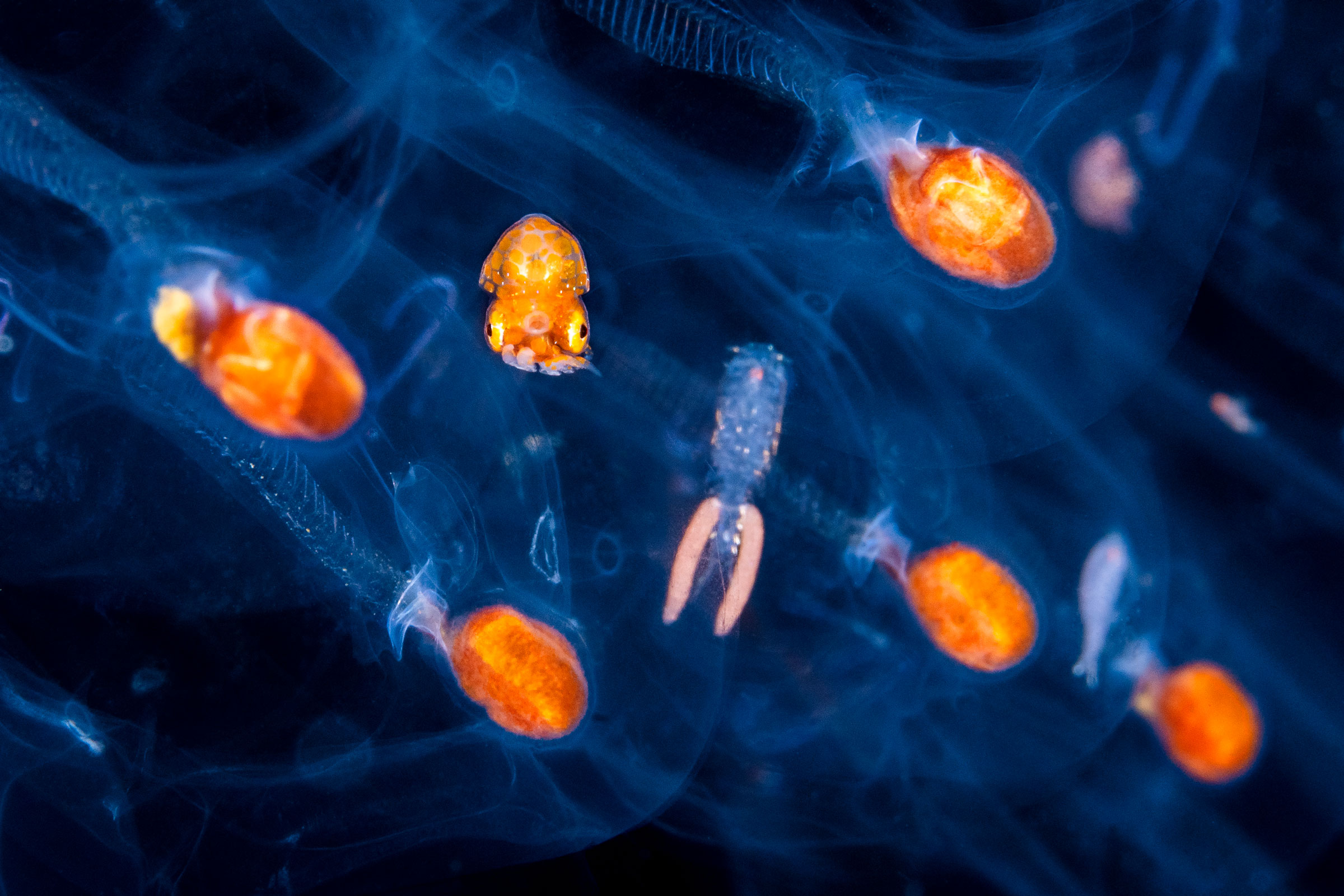
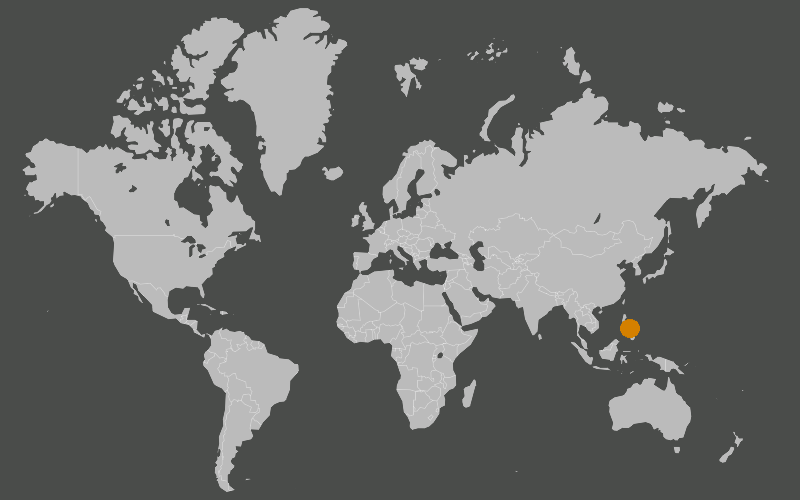
In a marine protected area in the Philippines, a brown paper nautilus (Argonauta hians) the size of a small olive peeks with bright, yellow eyes from the ghostly tangle of a salp chain. At first glance, the tiny male nautilus in this photograph looks to be in the company of several others of its kind, along with a copepod with fang-like appendages. But males of its species have evolved to be the same size and color as the guts of the salp (Salpidae spp.), a gelatinous zooplankton that forms long chains and provides the solitary argonaut with both transportation and the ability to hide in plain sight.
Despite their name, brown paper nautiluses are actually octopuses and are only distantly related to the iconic nautiluses that produce spiral shells. The octopuses are bite-sized snacks for birds, fish, and marine mammals when free-floating in the water, but when the males—who are much smaller than their female equivalents—cling to a transparent salp chain, they can sneak by undetected.
Individual salp range in size depending on the species; the biggest are a little longer than a Coke bottle. Composed almost entirely of water, they resemble blobs of jelly, but can feel rigid and spikey when in motion. During their asexual reproduction phase, they produce a chain of genetically identical clones that may stretch up to 15 meters (50 feet) long—about the length of a humpback whale. The clones work together, using jet propulsion to spiral up and down the water column while filter feeding on algae and other phytoplankton. To get a shot like the one above, photographer Alexander Mustard had to first locate the tiny octopus as the transparent chain twirled by. “It’s like [the brown paper nautilus] is on the rim of a bicycle wheel going round and round in front of you,” Mustard says. “You’re following it with a camera, trying to get it in frame and in focus.”
Scientists have studied hundreds of photos taken on marine dives, like Mustard’s, to determine that gelatinous plankton, such as salps and jellyfish, are by far the preferred vehicle for brown paper nautiluses. And they are not alone: Many species in the ocean—including drift fish, some crustaceans, jackfish, and copepods—spend a portion of their life clinging to plankton to evade predation, either during the larval stage or as adults.
Recently, scientists have discovered that salps transport much more than passengers. They play a pivotal role in the ocean’s carbon pump by ferrying carbon from the algae they consume near the surface into the depths during their daily migration, releasing it as fast-sinking fecal pellets.
A salp population can expand quickly when algae is abundant; in 2018, a salp bloom in the northeast Pacific Ocean grew big enough to cover a swath of ocean nearly the size of Connecticut. A study led by the National Oceanic and Atmospheric Administration in the United States estimated that, because of this dynamic, salps and similar organisms around the world may be pumping as much as 700 million metric tons of carbon into the abyss each year, equivalent to the emissions from millions of cars. For a creature that only lives a few weeks, this pelagic pack animal carries a heavy load.
Hi, I’m Dave, the executive director of bioGraphic. (And that’s my dog, Finn.) Thanks for taking the time to read this story.
Stories like this simply don’t get produced without financial support from readers like you. bioGraphic is not backed by a private company or owned by a billionaire. It’s an independent, nonprofit magazine. And one-quarter of our annual budget comes directly from reader donations.
We need your support more than ever, as governments slash funding for conservation and scientific research, placing even more ecosystems and wildlife at risk around the world. At bioGraphic, we’re steadfastly shining a light on the threats to our planet’s incredible biodiversity. And we’re showcasing the hard work of people bravely taking action to protect at-risk species.
bioGraphic publishes environmental reporting that you can’t find anywhere else: deeply researched, trustworthy stories that are also beautiful and captivating to read. We offer an antidote to reader apathy and doom-and-gloom news by revealing the wonders of the natural world and focusing on real solutions to big problems. When you finish a bioGraphic story, we want to leave you feeling informed, delighted, and inspired.
We don’t run ads or hide our stories behind a paywall. The readers who generously support bioGraphic allow our work to remain free for everyone.
Will you help us keep telling these crucial stories?

Authors

Related Articles
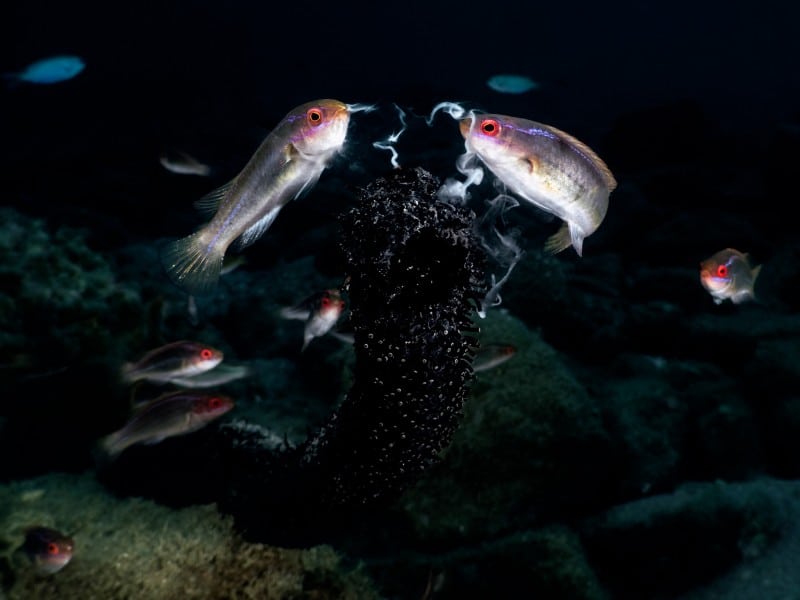
Milt Meal
Marine creatures will do almost anything for a meal—including feasting on the sperm and eggs of spawning invertebrates.
The Art of the Catch
To bulk up for winter hibernation, Alaska’s brown bears employ a range of techniques for snaring salmon.
The Wonder of a Pale Whale
A curious calf with an atypical birthday suit is a good sign for southern right whales.