
Story by Sarah Gilman
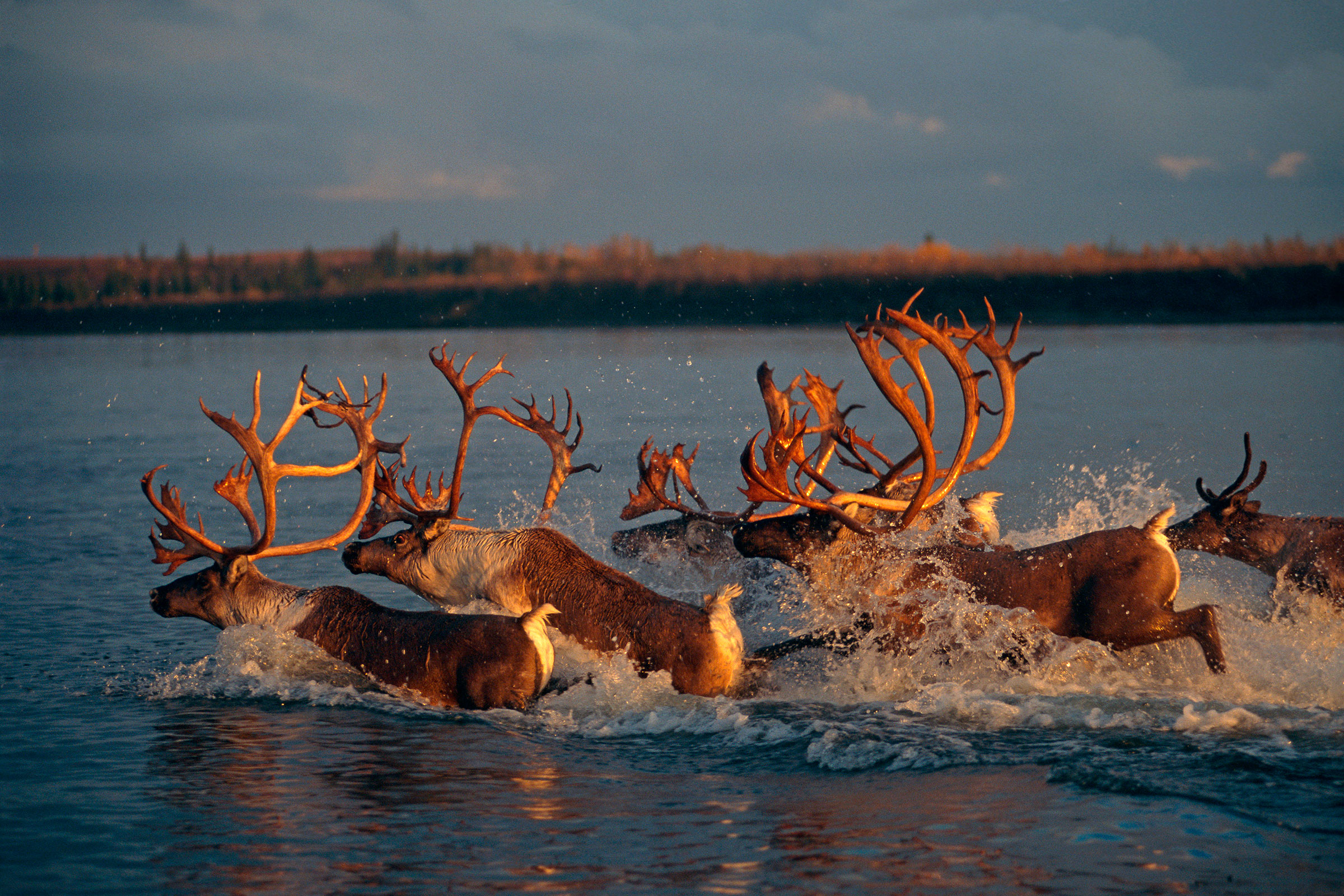
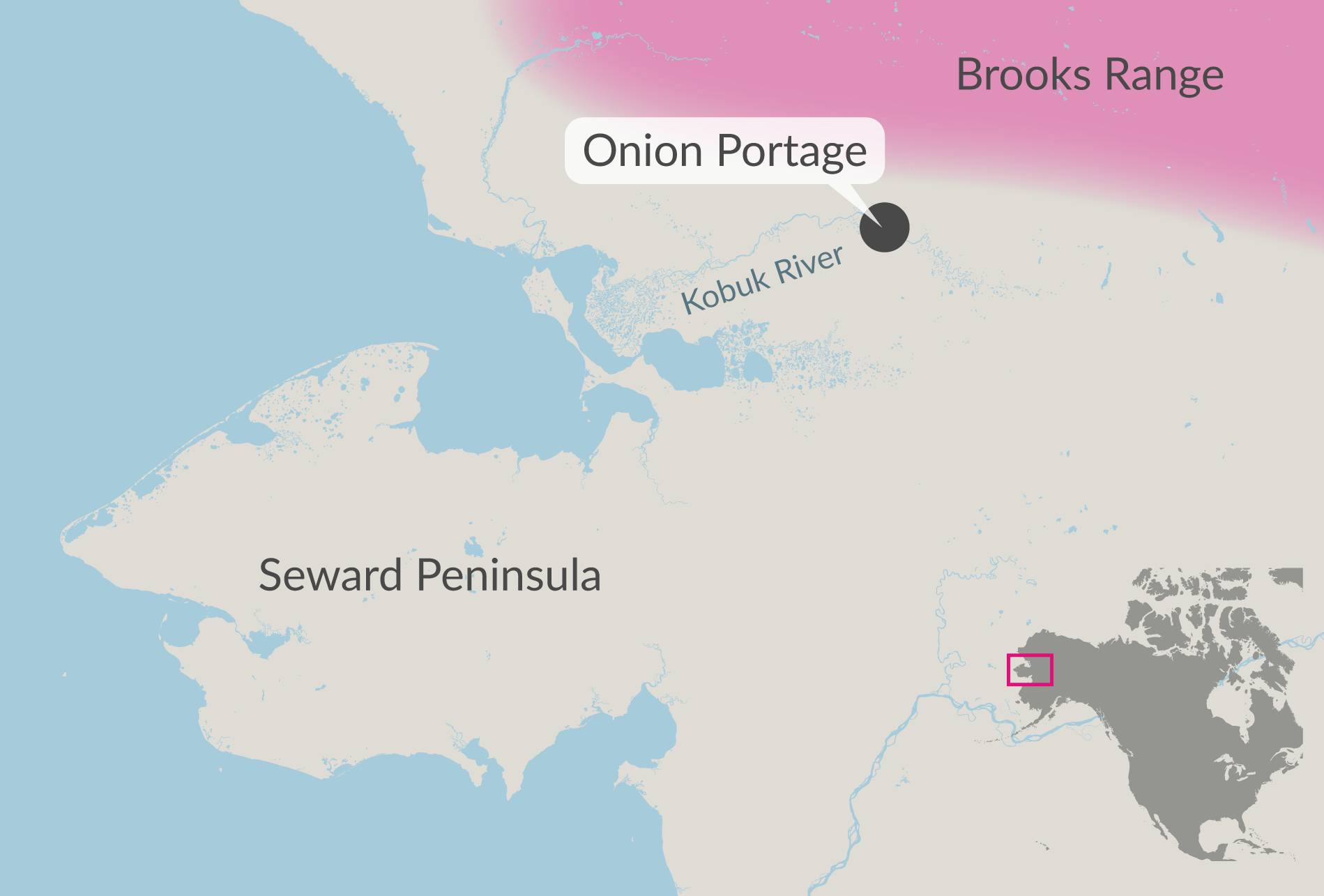
In northwestern Alaska, in a vast roadless landscape north of the Arctic Circle, there’s a place called Paatitaaq—Iñupiaq for the wild onions that grow there. In English, it’s called Onion Portage. From the air, it appears on a wide oxbow of the braided Kobuk River, flanked by scattered lakes and the mountains of the Brooks Range. Migrating caribou (Rangifer tarandus) have crossed the Kobuk at this remote place so reliably that Indigenous peoples have hunted there for more than 10,000 years.
For decades, that consistency also made Paatitaaq an ideal spot for state and federal biologists to catch up with swimming caribou by boat each fall to fit them with tracking collars—first radio and later GPS. Those collars have revealed the vast movements of the Western Arctic caribou herd in high resolution. Members travel up to 4,300 kilometers (2,700 miles) each year on their seasonal round. Although individuals and small groups often diverge from one another, much of the herd has generally flowed back and forth from their spring calving grounds on the northern slope of the Brooks Range to their winter range south of the Kobuk River, which includes the Seward Peninsula. But by 2020, many of the animals had stopped crossing the Kobuk to reach their wintering grounds altogether.
Map data by OpenStreetMap
A study released recently in Global Change Biology, based on GPS tracking data from 2009 through 2021, suggests one compelling reason for the migration change: caribou memory. Historically, more than 95 percent of collared animals that migrated to the Seward Peninsula and environs survived the winter. But after 2016, survival rates there dropped sharply, and more and more caribou opted to weather the bone-cold, snowy months 500 kilometers (310 miles) away, in the more challenging terrain of the mountains and valleys north of the Kobuk River. To understand the change, researchers constructed models that weighed factors that might influence caribou’s choices—like temperature, precipitation, and wind. They found that the strongest predictor of whether collared caribou moved south of the river was the previous winter’s death toll in that part of their range.
The caribou, researchers concluded, remembered the deaths of their kin or the conditions that led to them. Using that information, many chose a different location, where the survival rate ended up being slightly better and a lot more consistent. “We tried doing this in a bunch of different ways, and every single time … the results were still pretty solid,” says lead author Elie Gurarie, a wildlife ecologist at the State University of New York. “In a very, very big-picture way, [they] show that this range shift is driven by experience.”
The idea that animals learn and remember might seem obvious. But there are so many variables at play in the wild that setting up large, controlled experiments to prove it is nigh impossible, says Gurarie. Instead, researchers typically analyze and make inferences from observational data. And evidence keeps piling up that memory, learning, even culture—the social transmission of collectively accumulated knowledge—play significant roles in the migrations of large animals.
Whooping cranes, for example, can learn to migrate along their historical routes from surrogate crane-costumed human parents in ultralight aircraft. Matriarchs among African bush elephants transmit information about the landscape to younger females, improving the group’s overall reproductive success. In simulations built on tracking data from collared animals, researchers have shown that zebras and mule deer do a better job replicating known migrations when memory is factored in, rather than just cues about food availability or seasonal transition.
One landmark study, published in 2018, compared tracking-collar data for both established and translocated populations of bighorn sheep and moose in the western United States. The authors showed that populations in new environments stayed put at first and then became more and more migratory over time, as members learned to track the landscape’s seasonal resources and transmitted that knowledge to one another across generations. “That paper got a lot of traction,” says United States Geological Survey wildlife biologist Matt Kauffman. Kauffman also serves as lead scientist for the Wyoming Migration Initiative at the University of Wyoming, where former PhD candidate Brett Jesmer conducted the research. “It’s not uncommon to be at a meeting where more wildlife managers and even sportsman types now talk about migration as culture,” Kauffman says.
For a nomadic species moving through a landscape that is unpredictable from year to year, the utility of collective knowledge is clear. The Western Arctic caribou herd ranges across more than 360,000 square kilometers (140,000 square miles). It would be difficult for an individual to know where best to go in an area nearly the size of Montana. But together, the animals can find better ground, shifting their seasonal ranges as they learn—and as conditions change.
It’s not clear what caused more caribou to die southwest of the Kobuk starting in 2016. Winter—when the hordes of blood-sucking bugs are gone and bears are denning—is usually a good season for the species, which is adapted to the harsh conditions. But after 2018, the herd all but abandoned their southwestern range. It’s just one sign of hardship among many. Since hitting a high of 490,000 individuals in 2003, the herd plunged to just 152,000 in the most recent aerial census, in 2023.
The Arctic is among the fastest-warming regions on Earth, with corresponding changes in vegetation, permafrost melt, and weather. Increasing rain-on-snow events, for example, can leave a layer of ice over key caribou food sources such as lichen, making them difficult to access. Even though the recent caribou study can’t pin the drop in survival on such factors, it’s clear that “something is changing on the landscape that is making the southern winter strategy bad,” says Kauffman, who was not involved in the caribou research. The finding is important because “the caribou appear capable of behaviorally adapting to their changing landscape,” he adds. “For species like caribou, and I would say lots of other migratory ungulates, movement is perhaps the most powerful behavior that animals have.”
Should northwestern Alaska be fragmented by industrial development—including proposed oil-drilling expansions, open-pit mines, and a 340-kilometer (211-mile) mining road—caribou there may begin to lose that important tool. “The number one thing they need to survive en masse,” says Gurarie, “is freedom of movement over large landscapes.”
Related Articles
How Much Plastic Does it Take to Kill a Seabird?
For the first time, researchers uncover how eating plastic trash may impact seabirds at the population level.
Shrimp Shell Slurry to the Rescue?
A new, multistep chemical process can turn bits of organic waste into “carbon-negative” fuel, food, and construction material.
The Lonely Race to Save Ukraine’s Past
In a country ravaged by war, Ukraine’s conservators are torn between protecting the country’s past and fighting for its future.
