
This story was originally published by High Country News and is reproduced here as part of the Climate Desk collaboration.
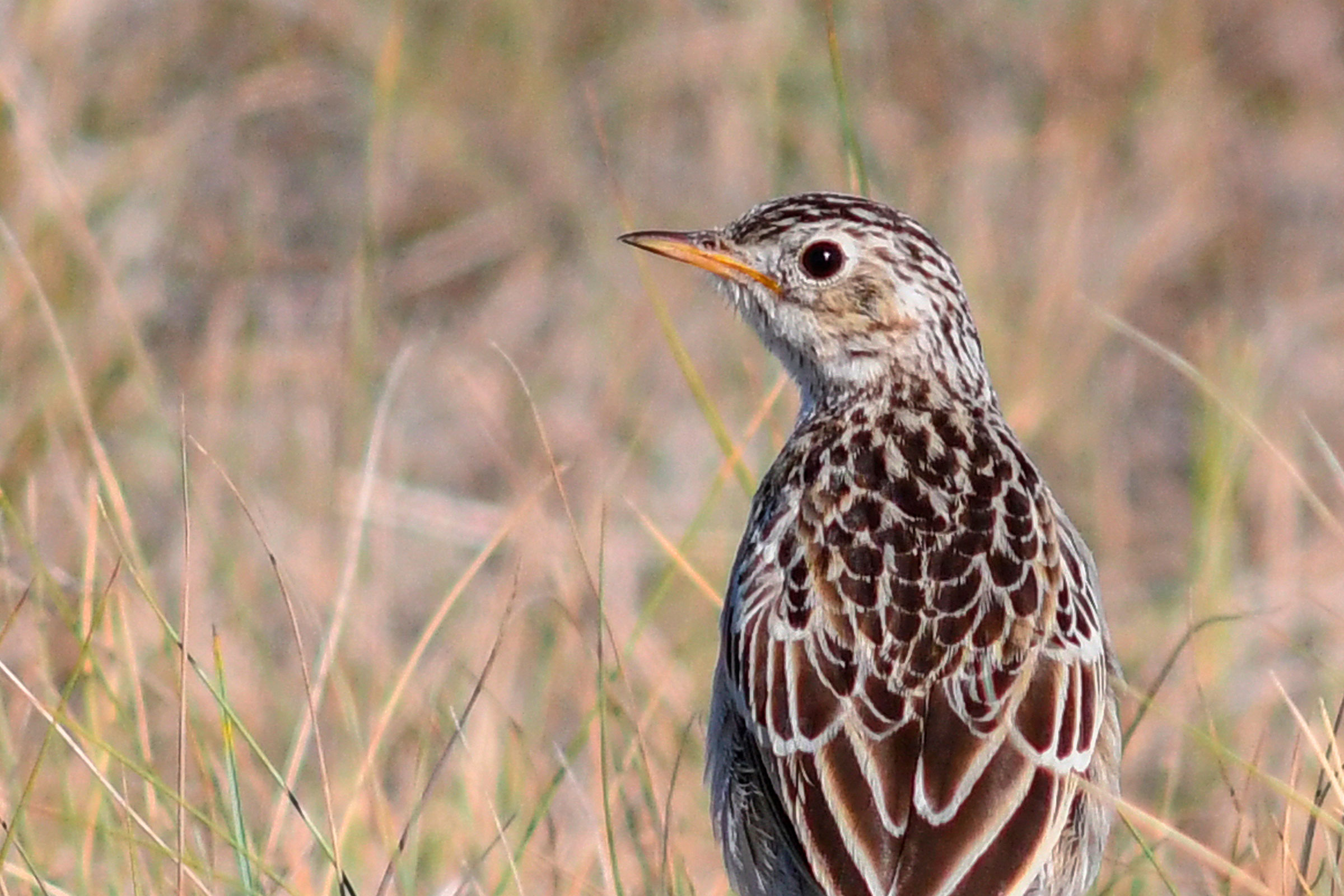
The male Sprague’s pipit was enraged. Flying in the June sky over the Montana prairie, he’d spotted a rival pipit singing in the swaying grass below. But when he dove to confront his adversary, he found himself face-to-face with a plastic replica, hand-painted with the songbird’s coffee-and-cream coloring and perched on a large portable speaker. The pipit had been duped. And as he tried to flee, he became enmeshed in a net that researchers had staked into the earth just moments earlier.
The migration routes of tiny songbirds like Sprague’s pipits (Anthus spragueii) have long been a mystery. Too little for standard GPS trackers, Sprague’s pipits also tend to shift their routes in search of the best habitat, making recapturing any of them virtually impossible. “We knew absolutely nothing,” says Andy Boyce, a research ecologist at the Smithsonian Conservation Biology Institute’s Great Plains Science Program and Migratory Bird Center.
About a decade ago, however, the advent of tiny radio-frequency tags made it possible to track hummingbirds, dragonflies and monarch butterflies. So researchers began to build towers that could pick up the tags’ signals, establishing what came to be called the Motus network, after the Latin word for motion. Today, a network of towers stretches from Canada’s Northwest Territories down to the southern tip of Argentina.
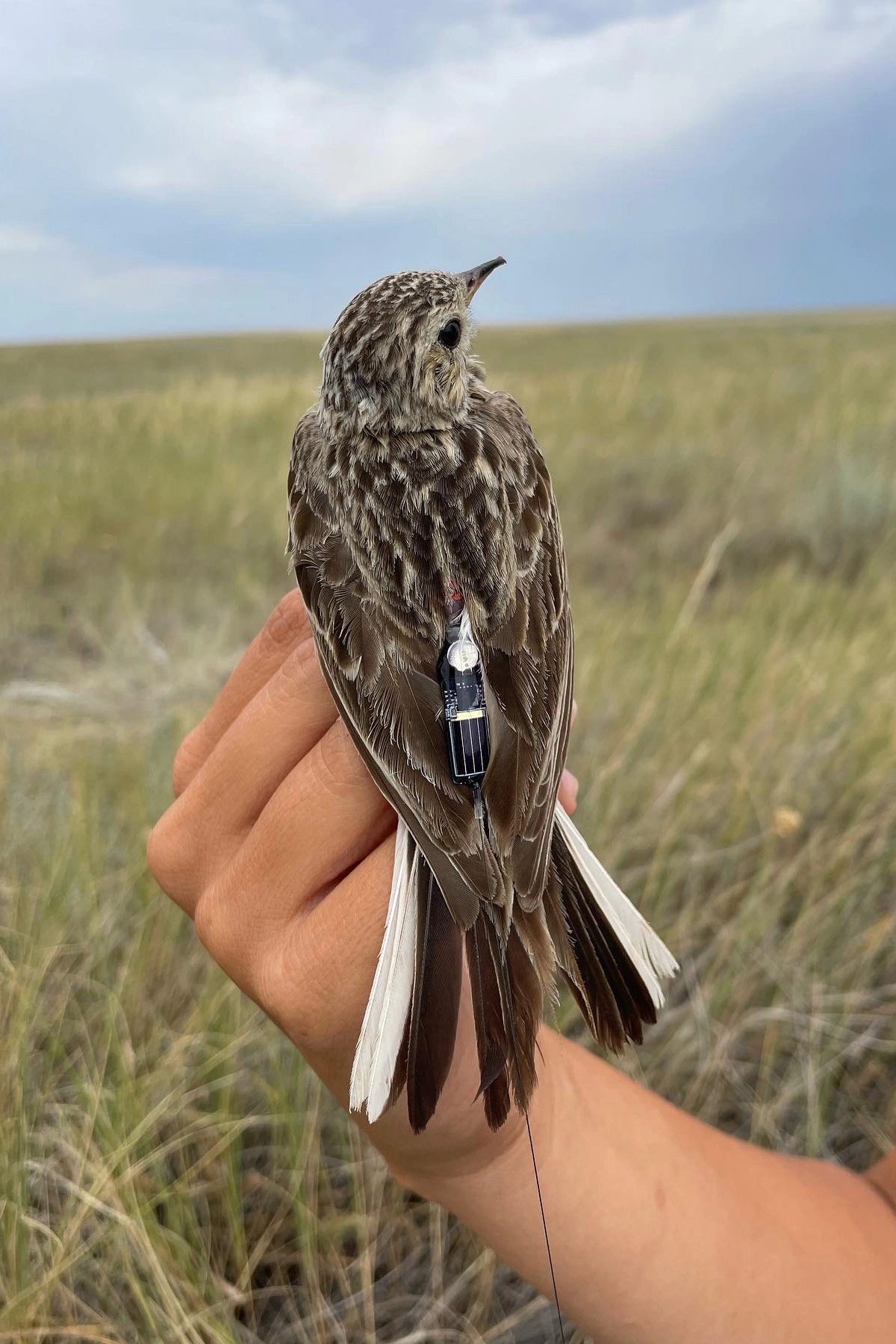
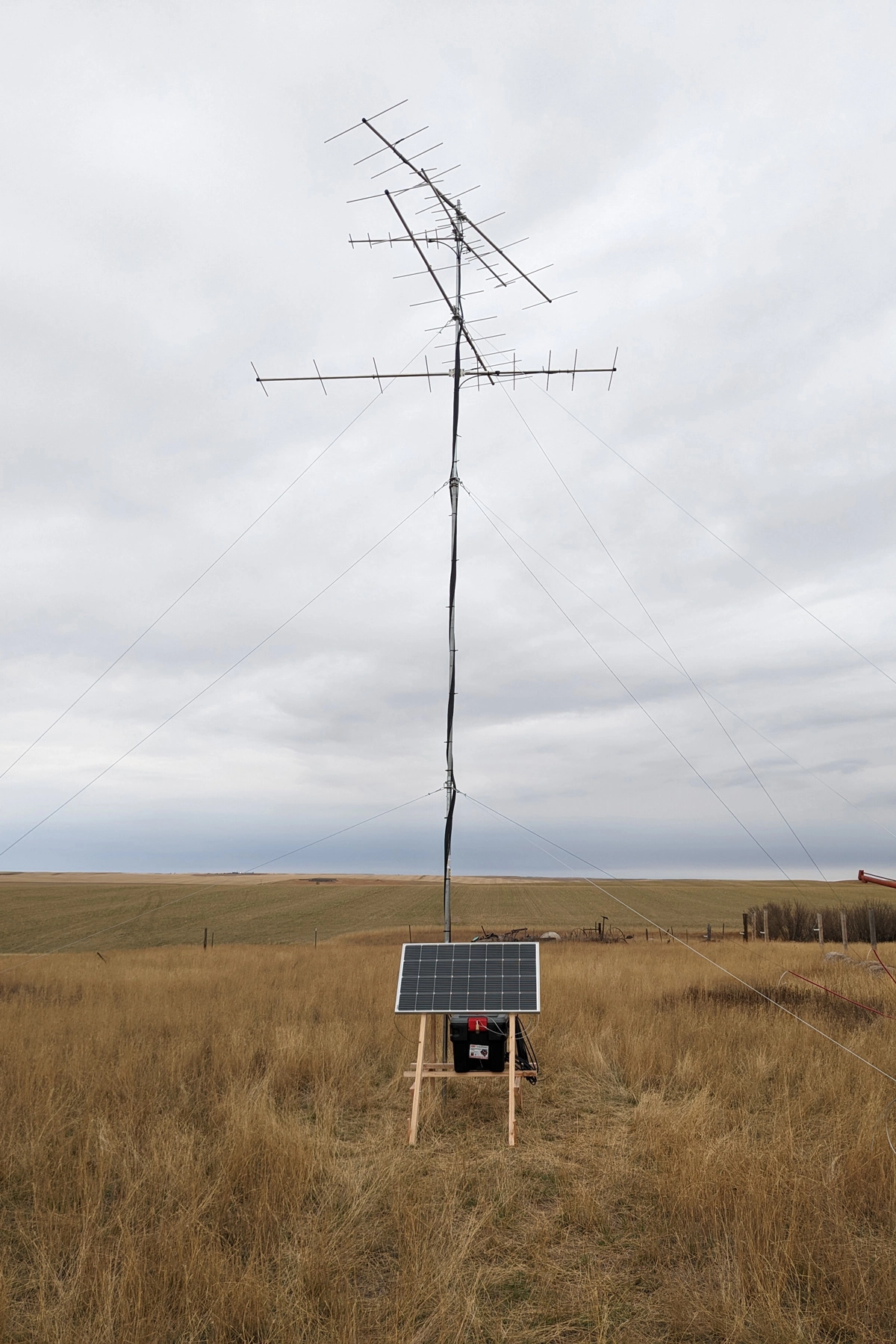
When a bird carrying an activated tag flies near a tower, it pings a Wi-Fi- or cell-service-connected computer at the tower’s base. While the tags don’t supply the animal’s precise GPS locations, they do offer information on its migration route, timing, and flight speeds.
The three researchers worked quickly to free the pipit from the net, recording its wing length and weight—about as much as two AA batteries—and gathering feather and claw samples. Nancy Raginski, a Smithsonian research fellow and PhD student at the University of Georgia, used a crochet hook to loop backpack-like straps under the bird’s wings, securing a Motus tag to its back. With a quick chirp, the pipit dashed away.
• • •
The Motus Network was the brainchild of Philip Taylor, a biologist at Acadia University in Nova Scotia. Automated radio telemetry was already being used underwater to track salmonids, and Taylor wondered if the same tiny tags could be used on birds, with receiver stations on towers.
Taylor, along with his master’s student Stuart Mackenzie and other collaborators, set up the first array of towers at the Long Point Bird Observatory in the hamlet of Long Point, Ontario, in 2010. Grant funding expanded the system to 150 more towers across Canada. Even more were erected in Central America, and by the mid-2010s, towers were popping up in the United States, first on the Eastern Seaboard and then throughout the West.
Continental-scale tracking began in earnest around 2015, when Swainson’s thrushes (Catharus ustulatus) tagged in Colombia were detected moving north, while Arctic shorebirds tagged in Canada’s James Bay were spotted traveling down the Eastern Seaboard to South America. Previously, the precise migratory paths of those birds had been unknown. “That’s when we realized that, OK, there’s great potential here,” says Mackenzie, now the director of strategic assets at the nonprofit Birds Canada.
In the decade since, researchers have tagged more than 55,000 individual animals belonging to more than 450 species worldwide, using over 2,200 stations installed in 34 countries. Researchers like Boyce usually build and maintain the 6- to 11-meter-tall (20- to 35-foot) towers themselves, working with landowners and government agencies to pick the right locations. Several people can set up a tower, which resembles an old-fashioned TV antenna, in about a day, and each tower requires two to three days of maintenance a year. The cows in Boyce’s research area like to rub themselves on the structures, sometimes bending them or even knocking them over, and at least one tower has been crumpled by a lightning strike.
Researchers have used Motus to learn not only where migratory animals go but how they navigate the landscapes and barriers they meet. They have confirmed that bats, for example, will both cross and avoid large bodies of water like the Great Lakes; that several species of birds fly around at night during migratory stopovers, likely seeking better habitat; and that some thrushes fly nonstop for more than 30 hours to cross the Caribbean and the Gulf of Mexico.
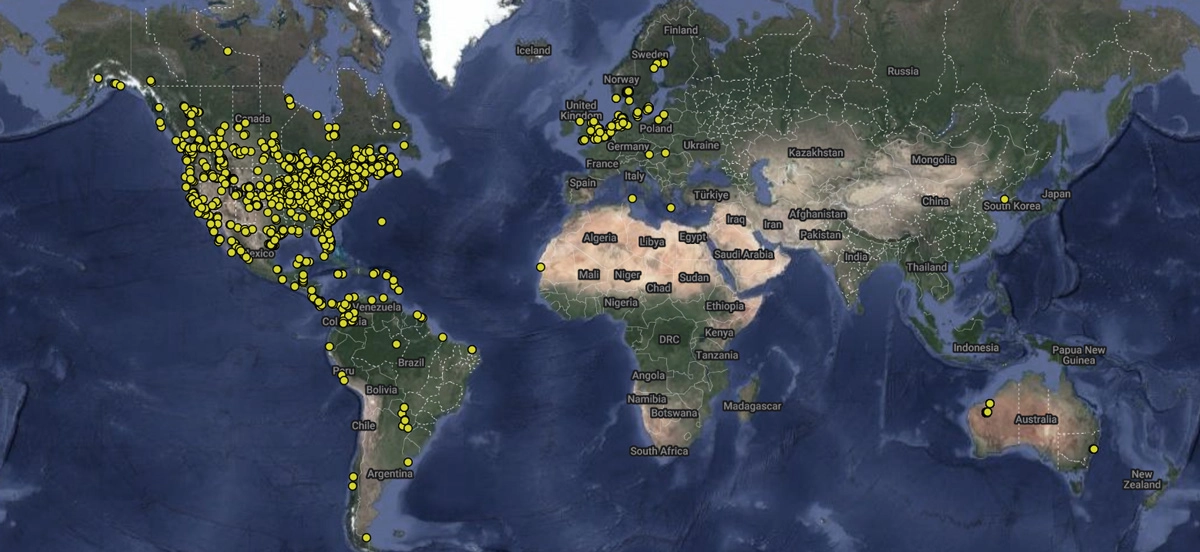
Motus depends on collaboration: Whenever a researcher sets up a tower, everyone else in the network gains a new data point. While researchers and their institutions maintain ownership of their towers, the data is shared. Birds Canada maintains the centralized database that makes the network available to scientists and the general public, so it’s more accessible than other popular migration technologies, such as the ICARUS (short for International Cooperation for Animal Research Using Space) satellite tracking project. Motus tags (at US $250) are also significantly cheaper than GPS tags, by tenfold or more.
“I could say it’s the largest research infrastructure on the ground for tracking and monitoring migratory animals,” Mackenzie says. “And it’s quite an enormous feat.”
• • •
Boyce’s team was catching Sprague’s pipits in the Missouri River grasslands—the best remaining temperate grassland ecosystem in North America, he says. It’s home to the Aaniiih and Nakoda tribes, and the researchers had tribal permission to work on the Fort Belknap Reservation. The little songbird is an indicator species for healthy grasslands; Boyce jokes that it has a “snobby” attitude toward shrubs. “If you protect them, you protect a whole bunch of other species,” he says. A petition to protect the Sprague’s pipit under the Endangered Species Act was found to be warranted by the U.S. Fish and Wildlife Service in 2010, but protection was delayed by higher-priority species.
Motus technology has allowed scientists to track the bird’s entire migratory path—from Central America through the Great Plains and up to southern Canada—without having to travel the continent themselves. “It’s like having giant nets across the Great Plains,” Boyce says.
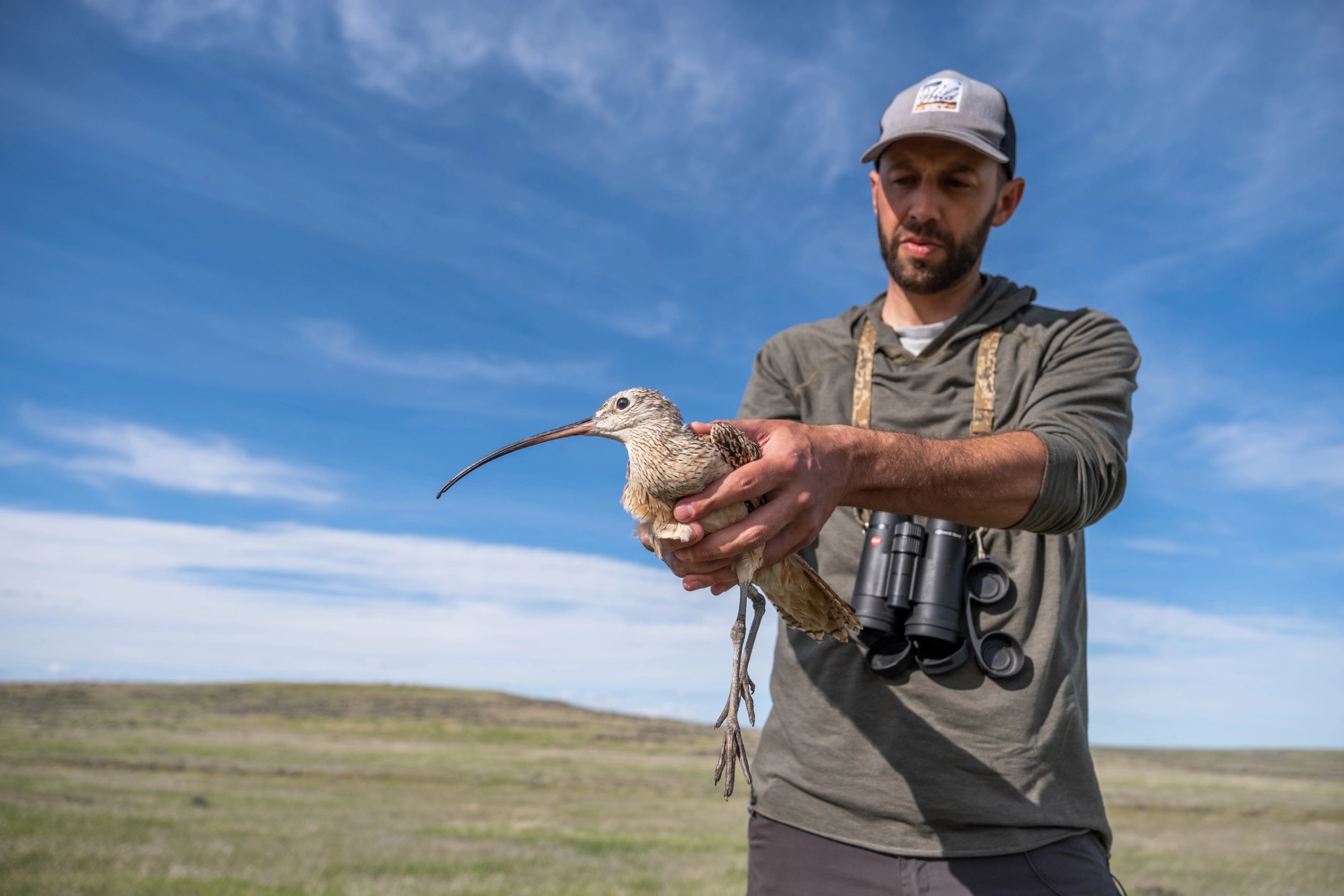
A grassroots approach to collecting data like this does have downsides: There’s currently no national plan for the technology in the U.S., so if a researcher loses grant funding or shifts to other projects, that can result in “orphan towers.” Earlier this year, staffing and resources were so low at southwest Montana’s Red Rocks Lake National Wildlife Refuge that a station went offline and stopped collecting data, Boyce says. There’s no one around to maintain the station or even allow Boyce access to fix it.
Some agencies are interested in helping fill the gap. Montana Fish, Wildlife, and Parks started funding its own stations using money earmarked for conservation from a 2021 tax on marijuana sales. The state’s nongame wildlife program received $1.1 million in the first year alone, effectively doubling its budget. “The main limitation of Motus in terms of understanding migration routes, connecting breeding grounds and wintering grounds, is just the number of stations,” says Kristina Smucker, a state wildlife biologist. “And that’s kind of where we came in.”
The agency has put up seven towers so far, with permission to erect eight more this summer, and it’s committed to setting up and maintaining a total of 50 in the next five years. Smucker says the agency is most interested in species of greatest conservation need—including grassland birds like the Sprague’s pipit and chestnut-collared longspurs (Calcarius ornatus).
• • •
Shortly after researchers lured the first Sprague’s pipit into the net, another bird followed in what researchers call a “BOGO”—buy one, get one free. They repeated the same data collection and tagging process before disassembling the nets and continuing their search, craning their necks to spot pinpricks in the sky.
The team covered about 5 kilometers (3 miles) of sagebrush and grassland, shimmying under barbed wire fences under the watchful eyes of cows. Some birds came down on the wrong side of the net. Others observed the decoy but never pounced. “You can’t be a better bird than a bird,” Raginski said.
By mid-afternoon, the team caught one more, bringing the day’s total to three and the summer season’s total to 35. Each could unlock a better understanding of what the species needs to survive. But even the finest technology cannot erase a hard truth of conservation: First, you have to catch the creature.
Hi, I’m Dave, the executive director of bioGraphic. (And that’s my dog, Finn.) Thanks for taking the time to read this story.
Stories like this simply don’t get produced without financial support from readers like you. bioGraphic is not backed by a private company or owned by a billionaire. It’s an independent, nonprofit magazine. And one-quarter of our annual budget comes directly from reader donations.
We need your support more than ever, as governments slash funding for conservation and scientific research, placing even more ecosystems and wildlife at risk around the world. At bioGraphic, we’re steadfastly shining a light on the threats to our planet’s incredible biodiversity. And we’re showcasing the hard work of people bravely taking action to protect at-risk species.
bioGraphic publishes environmental reporting that you can’t find anywhere else: deeply researched, trustworthy stories that are also beautiful and captivating to read. We offer an antidote to reader apathy and doom-and-gloom news by revealing the wonders of the natural world and focusing on real solutions to big problems. When you finish a bioGraphic story, we want to leave you feeling informed, delighted, and inspired.
We don’t run ads or hide our stories behind a paywall. The readers who generously support bioGraphic allow our work to remain free for everyone.
Will you help us keep telling these crucial stories?

Related Articles

Trees as Public Health Infrastructure
New research shows that meeting tree canopy goals could prevent more than 67,000 premature deaths in the United States.
A Mite on a Bee on a Ship on the Sea Spells Trouble
Pollinator pathogens are spreading through international trade, threatening both agriculture and wild ecosystems.
When it Comes to Frog Sex, Teamwork Makes the Dream Work
New science on gray foam-nest tree frogs hints at the evolutionary benefits of multiple sexual partners.