
Story by Elizabeth Miller
Photographs and video by Christina Selby
Wildlife biologists Emily Macklin and Amy Seglund stride through a grassy meadow early on a May morning, heading toward the woodlands lining central Colorado’s Arkansas River Valley. The blue peaks of the Sawatch Range loom on the western skyline, and wisps of clouds draped against their ridges glow in the rising sun. Macklin scans a map on her tablet, then lifts her gaze at a kaw from nearby trees.
“There’s a jay,” she says.
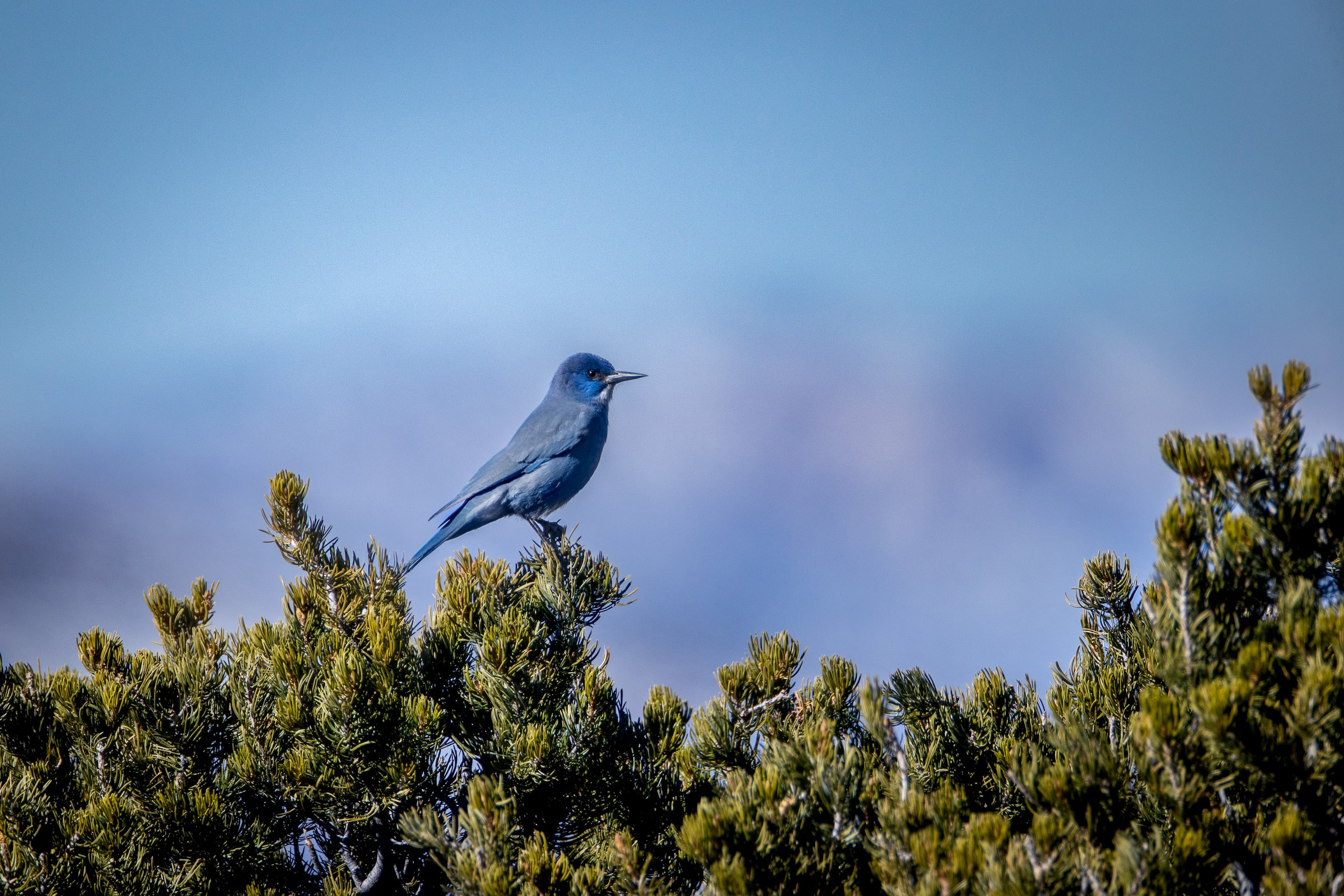
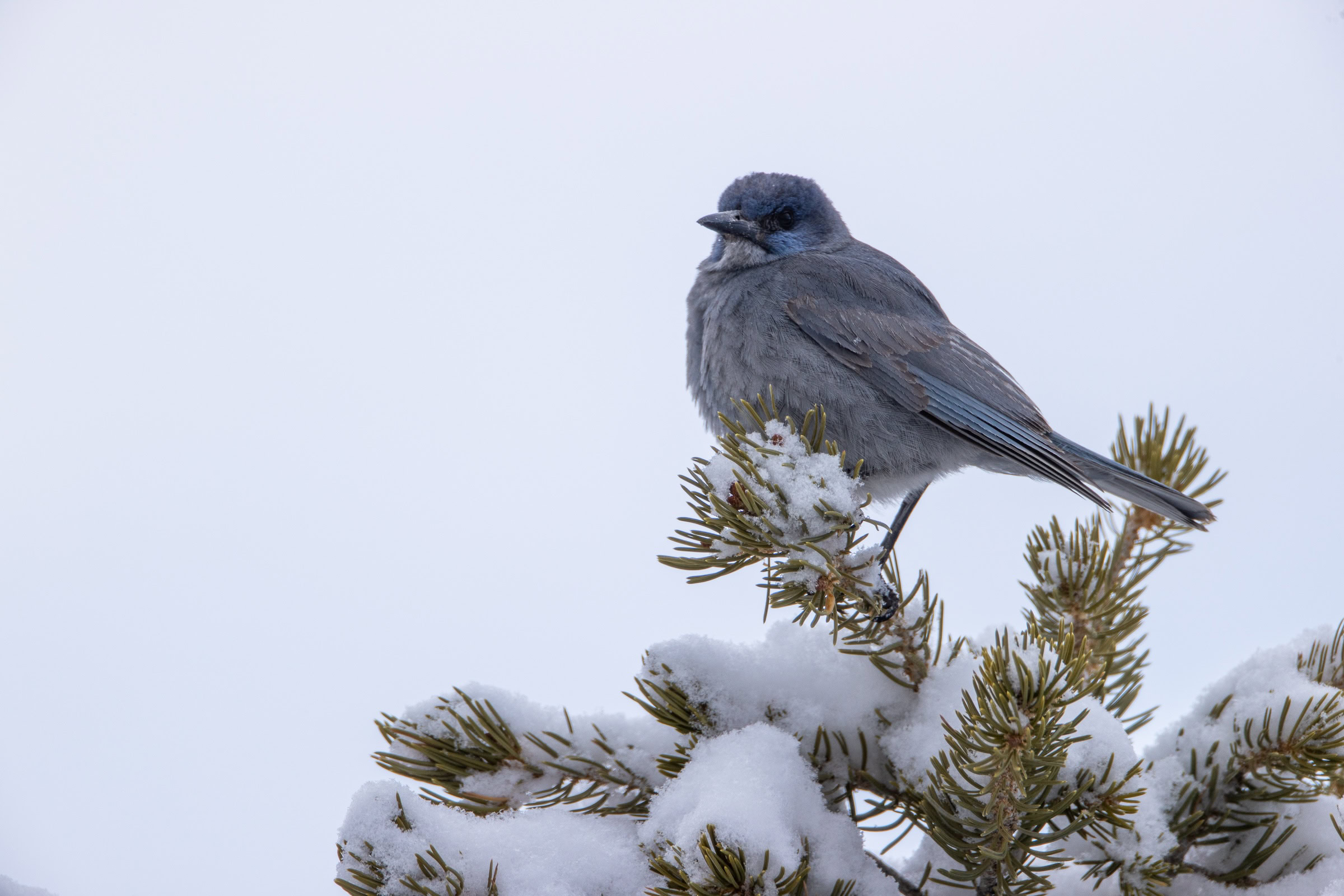
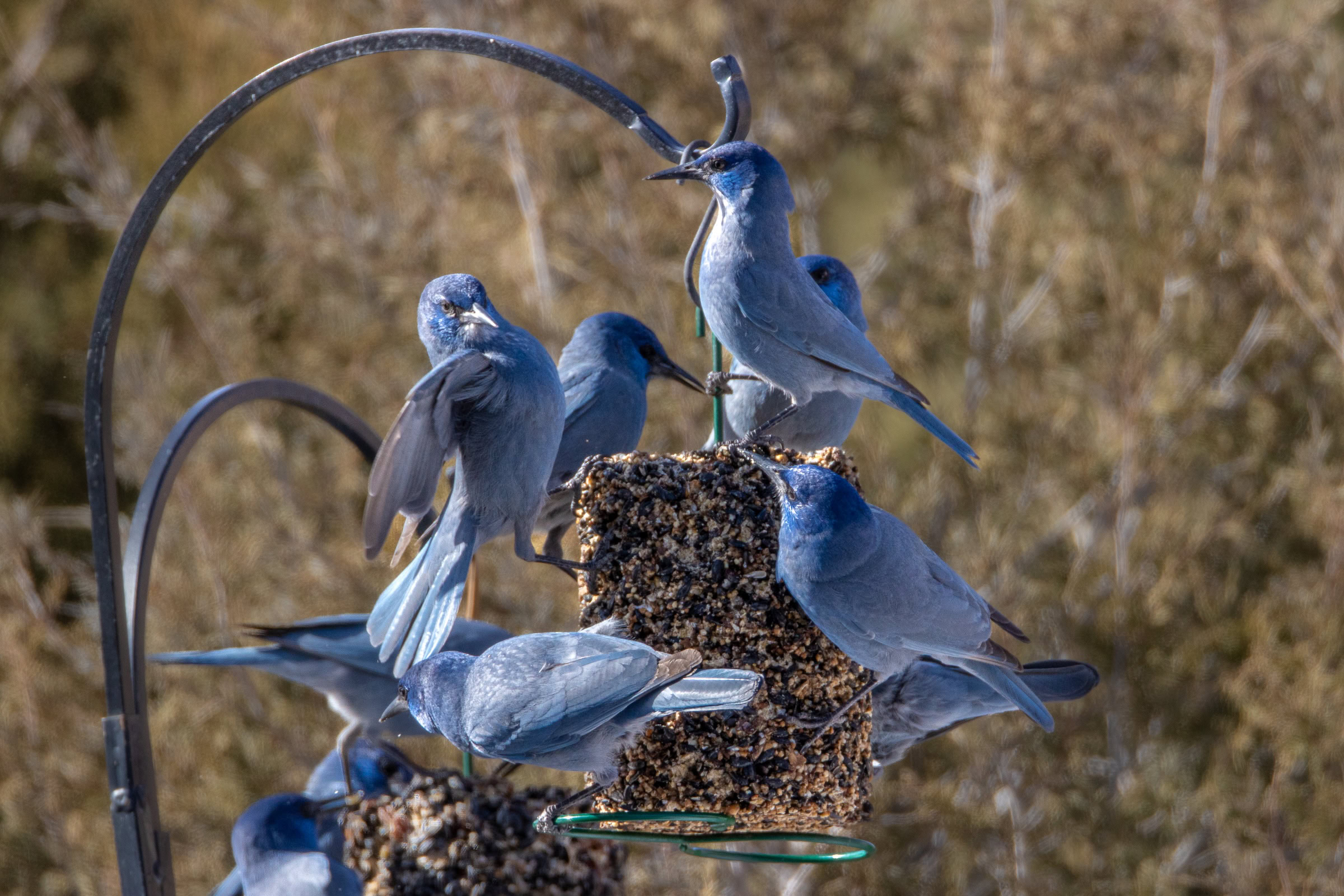
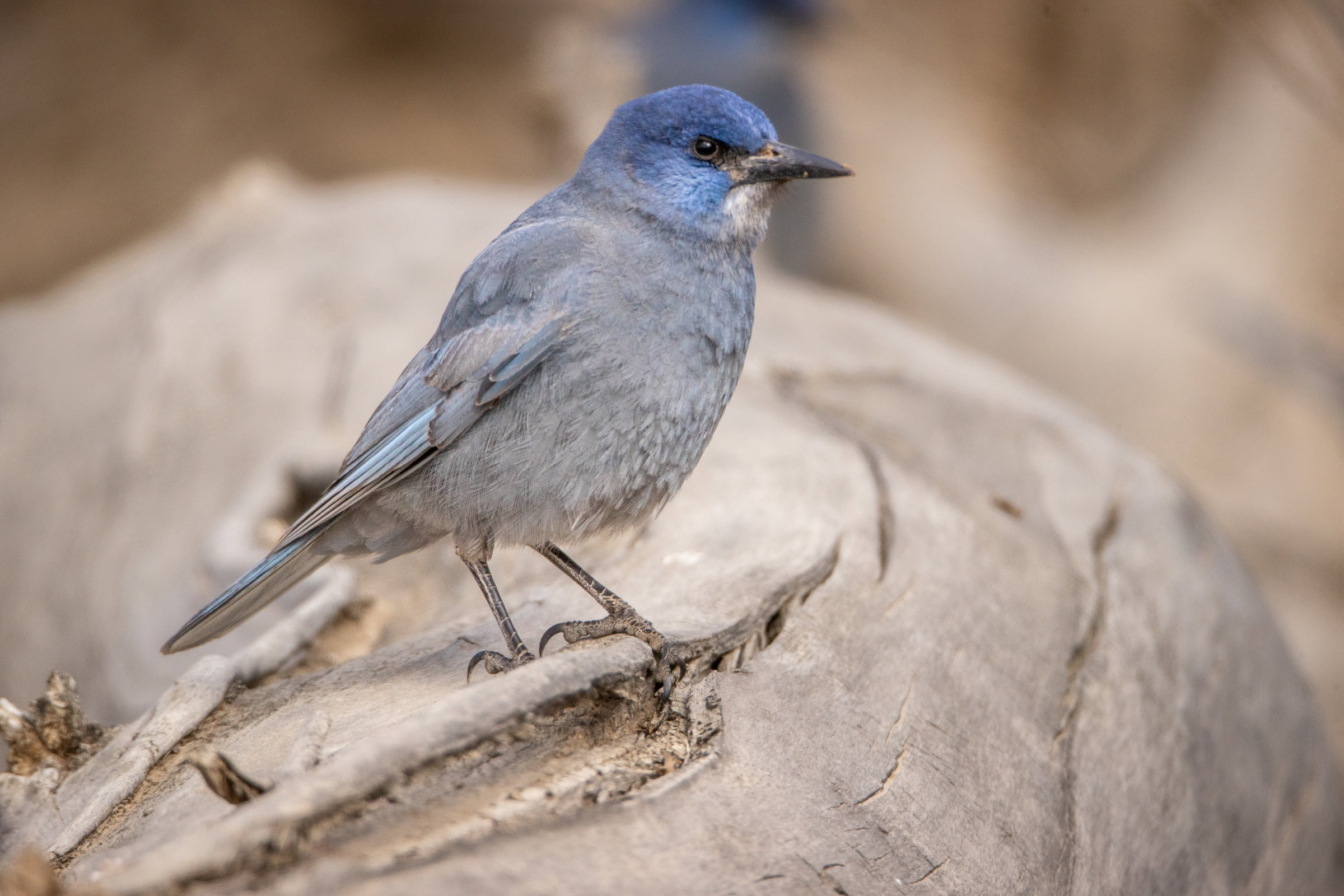
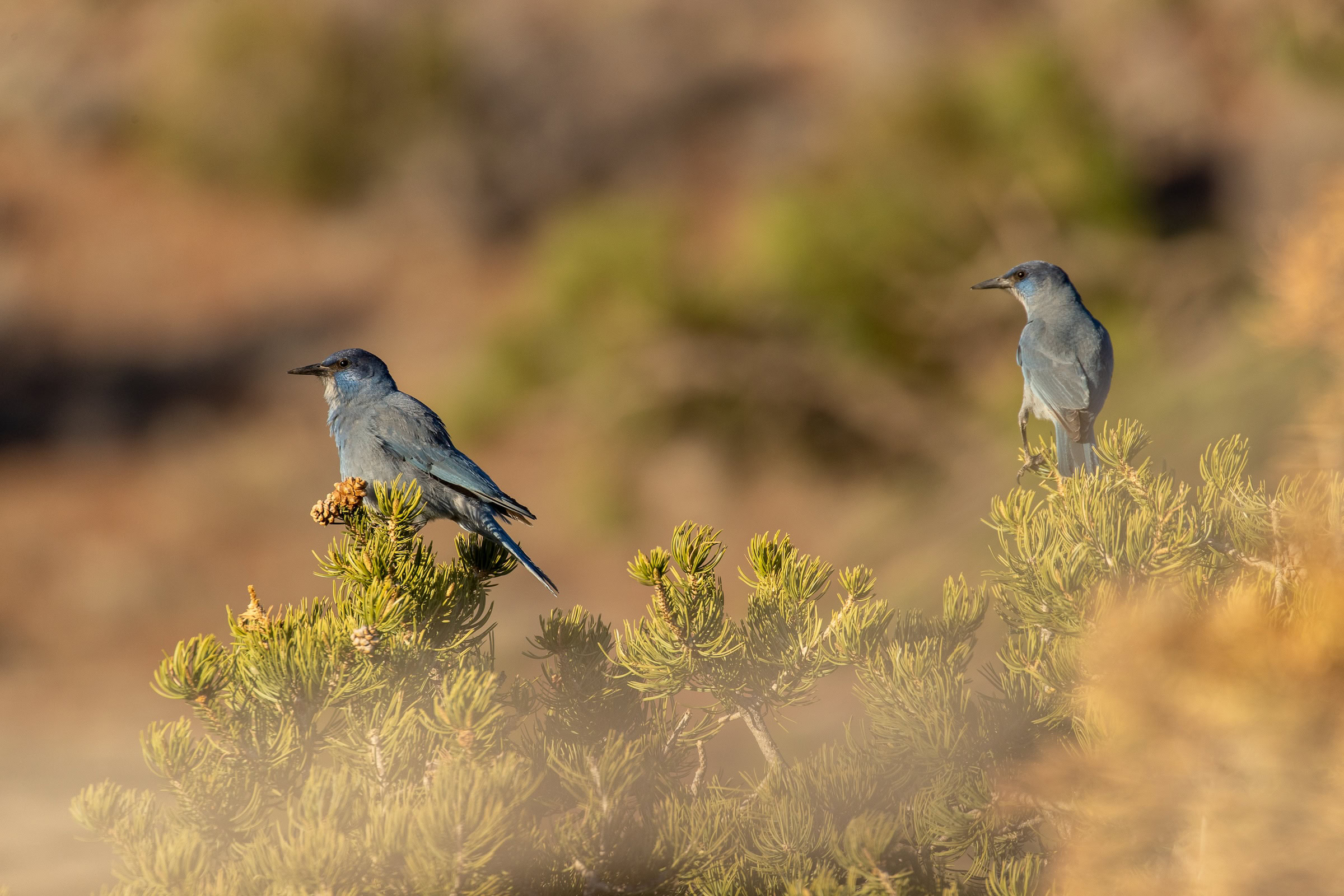
We follow quavering calls across a highway, over a barbed wire fence, and up a hillside. Recent rain has left drops dangling from pine needles and the bark wetly dark. The signature sound of the pinyon jay (Gymnorhinus cyanocephalus)—a chortling kaaww, ahh, ahh—rises from the forest ahead. Then we spot blue and gray feathers flitting among the branches. Darker blue adult jays, slightly larger than a robin, alight near treetops, while grayer, fluffier fledglings shadow them, popping open red mouths to peep and beg. They gather, then scatter. A trio struts along the forest floor, prodding the grass with long, straight bills, while an adult picks at a cone as though searching for something to stuff into the bleating fledgling mouths. The flock drifts closer, and soon we’re ringed in sound and color and movement.
“This is really cool to see,” Seglund says in a near-whisper, tossing her backpack onto damp ground and sitting on it to watch. Her last study on pinyon jays’ nesting success returned grim numbers, the nestlings often lost to predating ravens, so she’s glad to see a flock successfully raising young.
Macklin, for her part, is glad to see the birds at all. A few weeks before, she was out looking for pinyon jays with the U.S. Fish and Wildlife Service and didn’t find a single one. Likely, they’d just finished breeding and dispersed, but when she’s bringing an audience out to see the local population, it’s nice to find a few.
A few decades ago, flocks of several hundred pinyon jays were a common sight in the American Southwest. The Hopi call them a “bird of war” for their fearlessness against predators; groups have been known to dive and squawk at hawks, great-horned owls, gray foxes, and coyotes. Flocks hopscotch restlessly through massive home ranges of up to 15,000 acres, present one day and gone the next. Now, however, it’s an occasion to spot more than a few dozen at a time during the breeding season. Across their range, the number of these charismatic, sociable corvids dropped by an estimated 83.5 percent between 1967 and 2015, from more than 3 million to a current estimate of 690,000 birds.
While the jays’ decline is dramatic, it isn’t unique; a 2022 review found that about half of all bird species around the world are likely suffering population declines. Generally, that’s linked to habitat loss or degradation, though climate change and over-hunting for food, sport, or the pet trade play roles as well. But pinyon jays present something of a paradox.
“The footprint of their primary habitat has not shrunk drastically—not nearly enough to explain their decline,” says John Boone, who has studied pinyon jays with the Nevada-based Great Basin Bird Observatory for 16 years. “So there’s something else going on, changes in those woodlands or in the whole landscape, and that’s harder to figure out, frankly, than just a straight-out loss of habitat and no place left to live.”
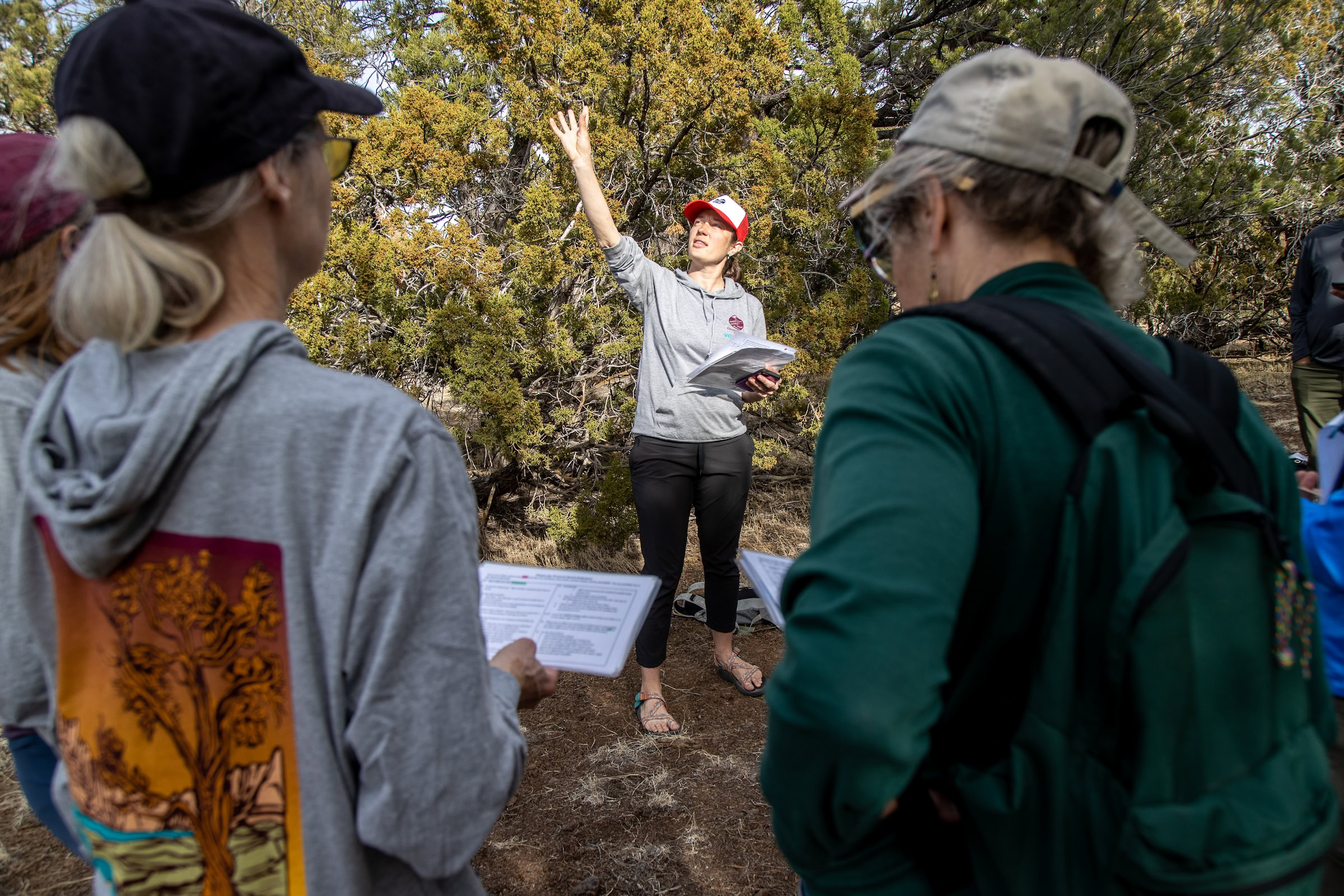
Seglund, a species conservation program manager with Colorado Parks and Wildlife, and Macklin, a longtime bird researcher studying pinyon jays as part of her graduate work, are among the scientists trying to answer the questions nagging land managers, bird watchers, and wildlife advocates throughout the Southwest: What is causing pinyon jay populations to plummet? And can sorting out the answer help us better care for one of the West’s most abundant and least appreciated forests?
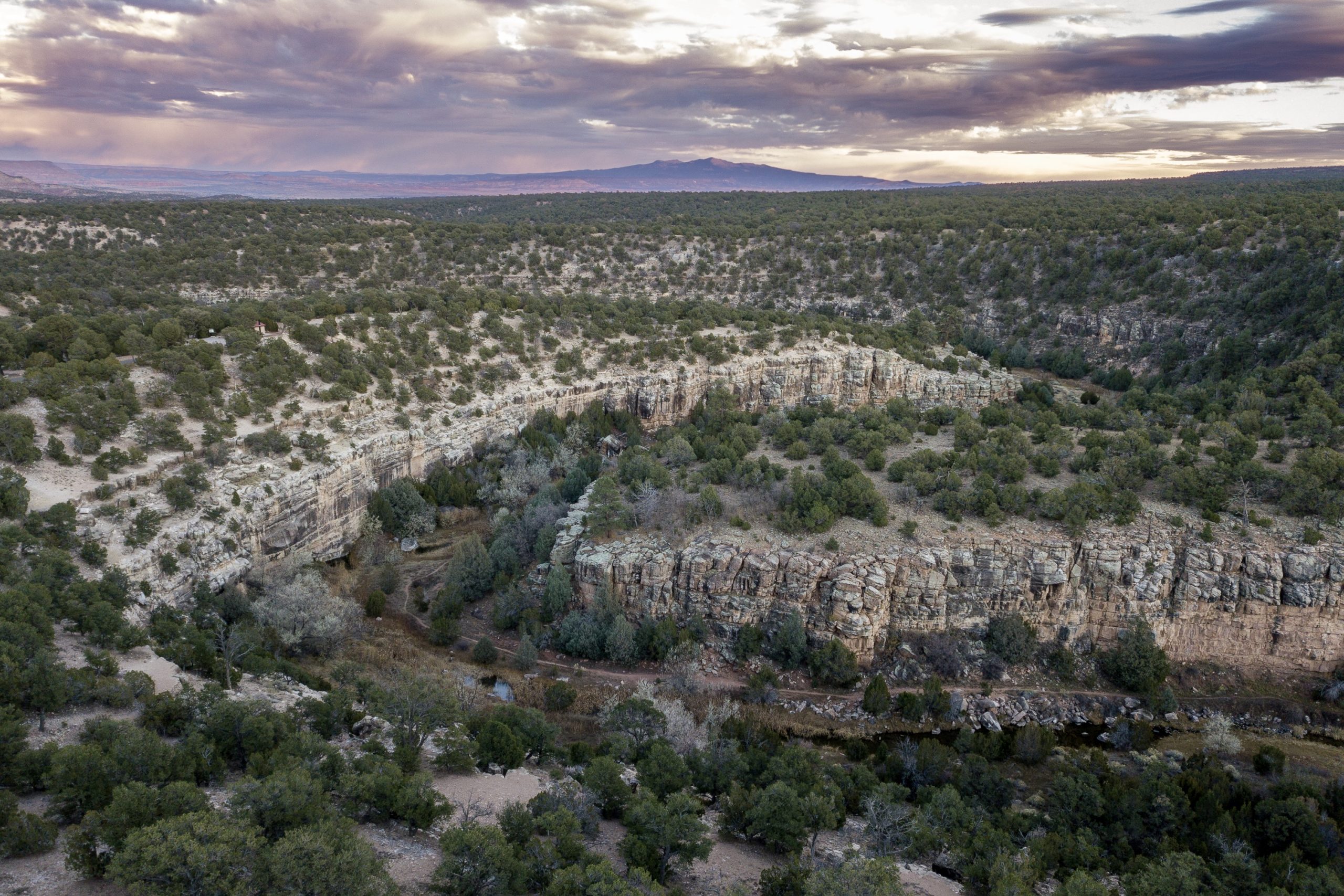
Pinyon pines’ branches burst into a canopy just above the ground. Without a long trunk hefting these uppermost branches skyward, it’s possible to stand nearby and look almost eye-to-eye with birds in the overstory. Pinyon pines commonly intermingle with junipers, creating an ecosystem known as pinyon-juniper woodlands that grows in places so dry and rocky that most other trees struggle to survive. In these arid regions, pinyon-juniper woodlands provide shade, shelter, and forage for a suite of plants, mammals, reptiles, and pollinators, along with about 70 species of birds—including pinyon jays, which live closely tethered to these trees.
Altogether, the pinyon-juniper ecosystem covers perhaps as many as 100 million acres in Arizona, Colorado, New Mexico, Nevada, Utah, and other parts of the West. John Muir observed vast, continuous swaths of it as he rambled across Nevada in the summer of 1878; he described entire mountain ranges blanketed with pinyons, a “curious little conifer” that exceeded in number all other trees combined. But apart from such anecdotes, there’s little record of the historical extent of these woodlands.
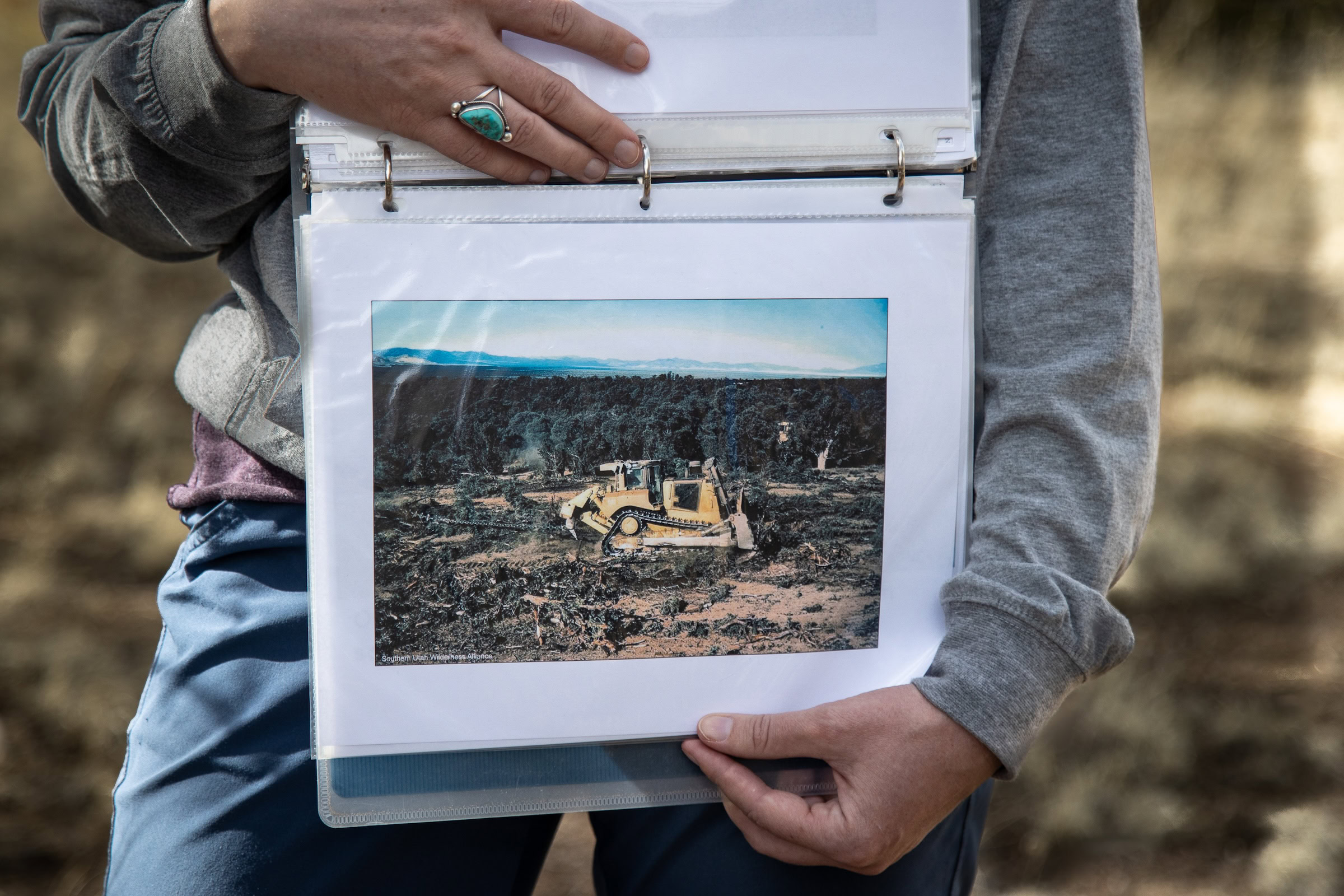
Still, early colonists are thought to have cut millions of acres of pinyon-juniper forest as they built towns and cleared land for farms and ranches. Nevada’s mines and smelters alone consumed an estimated 600,000 to 750,000 acres of pinyon-juniper during its 19th- and early 20th-century silver boom. Well into the 20th century, land owners and managers treated the ecosystem as a wasteland, since the trees aren’t straight or tall enough to produce useful lumber. Untold acres were bulldozed, burned, chemically treated, masticated, or chained, a process by which bulldozers drag chains over the ground to rip out trees. Between 1950 and 1964, ranchers cleared more than 3 million acres of pinyon-juniper forest to create rangeland for grazing livestock.
Pinyon-juniper removal continues today, with controversial thinning projects aimed at reducing fuel for wildfires, creating more rangeland, or protecting endangered species. Still more have been lost to drought, climate change, wildfire, insect infestations, and development.
The math here would seem to land on subtraction, but in some places, pinyon-juniper forests have reclaimed their former range, and even seem to be adding to it. Some researchers claim there’s more pinyon-juniper than ever. In Idaho, Nevada, Oregon, and Utah, for instance, the trees have “encroached” into grasslands and sagebrush, increasing the area they occupy by up to 625 percent since 1860 in some spots, perhaps because of decades of wildfire suppression. In some regions, junipers seem to be faring better than pinyons in that effort, leading to a pinyon-juniper woodland that’s mostly juniper, with few of the nut-producing pinyons. Other researchers, however, contend that dramatic increases in trees in one area may well be matched by equally dramatic mortality events in another.
Yet trying to figure out how many acres have been added or lost for a forest type that spans 13 states and several species of pinyons and junipers may not be the right line of inquiry. Perhaps, says Patrick Magee, a professor of wildlife and conservation biology at Western Colorado University, one of the emerging problems with pinyon-juniper habitat lies with quality as much as quantity.
Unfortunately, scientists and resource managers have historically paid so little attention to pinyon-juniper compared to other western woodlands that they’re still figuring out what healthy pinyon-juniper forests look like—and how nuances in forest composition and structure may be affecting the population of a bird so inextricably tied to this forest that the two share a name.
“People really don’t understand the dynamics of these forests very well,” says Magee. “One of the big shortcomings in management and research is assuming all these forests are the same—[pinyon-juniper] is [pinyon-juniper], but it’s not.”
After the flock of jays drifts downhill into the Arkansas River Valley, Seglund and Macklin hike uphill toward a rocky skyline, searching for additional flocks. Instead of more birds, though, Seglund spots one of last year’s cones on a pinyon pine branch and snaps it off to show me. These cones—or the lack of them—may factor into pinyon jays’ decline.
Pinyon cones emerge in spring as a tan-and-green knot at the tips of bunches of pine needles. It takes two to three years of summer sun, monsoon storms, and winter chill for the “conelets” to mature to a knobby ball of tightly sealed scales concealing chocolate-colored seeds, or nuts. The nuts are so large and heavy that they require animals to disperse, instead of floating on the wind like the small, winged seeds of many other conifers. Several animals—including bears, squirrels, and nutcrackers—help pinyon pines broadcast their seeds, but pinyon jays and pinyon pines share a particularly mutualistic relationship.
Seglund pries open the cone to free one of its nuts, about the size of a shelled peanut, and soon her fingers are sticky with sap. While other corvids, like blue jays and ravens, grow feathers over their nostrils, she explains, pinyon jays don’t, perhaps an adaptation to this pitch-covered food source. Pinyon jays can hold more than 50 nuts in a throat pouch, then fly for miles before caching underground sometimes as many as 20,000 seeds a season. They recover 90 to 95 percent of their buried stores, but the forgotten 5 to 10 percent accidentally plants new pinyon pines.
tree. More than 70 species of birds are known to breed in piñon-juniper woodland and they support one of the highest proportions of obligate or semi-obligate bird species among forest types in the West. That means they depend on this habitat for all or part of their life cycle.
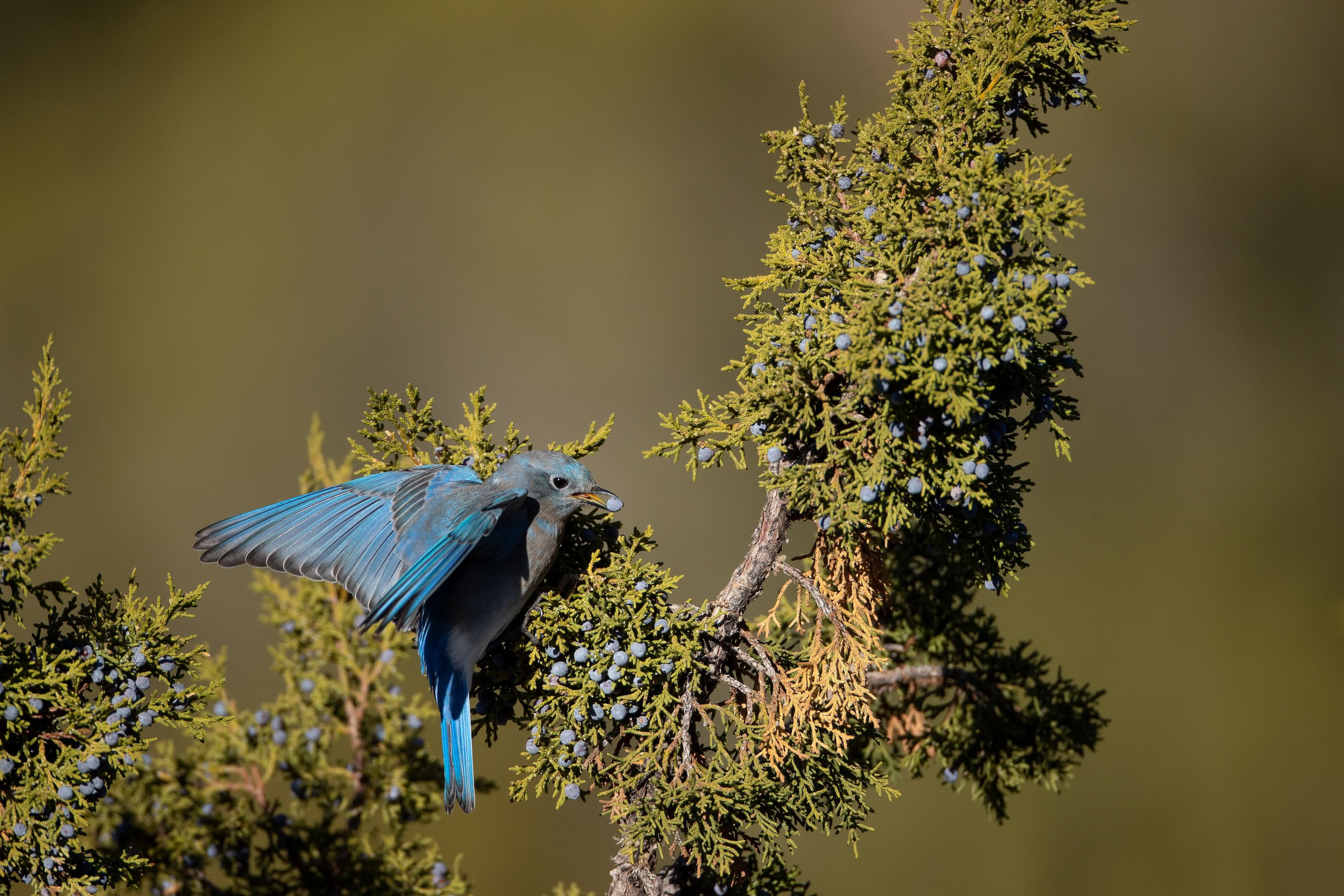
Birds in particular are critical to the dispersal of the seeds of piñon and juniper trees. The seeds of juniper trees cannot germinate until the fleshy covering of the seeds has been removed, which is usually accomplished by passage of the “berries” through the digestive tract of a bird or mammal. Depending on the species, juniper fruit may take one to two years to ripen, so it’s not unusual to find both green (unripe) and blue-red (ripe) fruit on the tree at the same time.
The jays are compelled to stockpile both by pinyon pines’ short masting season and its loosely understood irregularities. Some years, almost every tree in an area will be laden with seed-bearing cones. Other years, the trees produce virtually none. Pinyon jays are highly dependent on this fat-rich food source: A plentiful nut crop one year correlates to nesting success the following spring. Like most birds, pinyon jays’ reproductive organs shrink to non-functional size outside of breeding season, so that their bodies are lighter for flight. If the previous fall has yielded few cones, the birds may skip breeding. But uniquely, at the mere presence of green pinyon cones in late summer or early fall, pinyon jays return to reproductive condition.
“This co-evolved mutualism is really lovely, but it also figures into the decline of the bird,” Kristine Johnson tells me later. Johnson recently retired from running a pinyon jay research program through the University of New Mexico and is now a senior research scientist with Animas Biological Studies in Durango, Colorado. She has studied pinyon jays for more than 20 years, and seen nesting colonies completely vanish from an area after its pinyons died. As the climate gets hotter and drier in the Southwest, droughts are becoming more common, which can weaken or kill even drought-tolerant pinyon pines. Drought also makes the trees more susceptible to bark beetle infestations, and causes them to produce fewer nuts, both in terms of smaller crops and more years between them. For pinyon jays, this makes reproduction challenging.
“And if they defer and defer and defer [breeding] while they wait for good food,” Johnson points out, “then the population obviously is not going to be maintained.”
Another factor in the jays’ decline may have to do with age of the Southwest’s pinyon-juniper forests. Pinyon pines can live up to 600 years, but in many areas, they’re now less than 140 years old because so many were cut in the 19th and 20th centuries. Since pinyon pines take decades to mature—growing for 25 to 35 years before bearing cones and 75 before yielding robust crops—centuries of forest clearing might now be conspiring with climate change to deprive pinyon jays of their most important food source.
Another piece that scientists and conservationists are trying to figure out is how past and current fire management may impact the jays’ survival. Some think that a century of wildfire suppression has led to overly dense forests that deprive pinyon jays of the mosaic of mixed-age trees in which they thrive. This line of argument favors thinning dense stands to prevent destructive wildfires. But that could also rob birds of nesting habitat. Further complicating the puzzle, other scientists claim that pinyon-juniper forests aren’t adapted to wildfire at all, and have documented projects aimed at thinning fuel loads actually increasing grass cover—a fuel for more wildfires, raising soil temperatures, and depleting living soil crusts, a crucial building block for ecosystem health. Land management practices, like historic and ongoing thinning, grazing and clearing efforts for other endangered species like greater sage grouse, have also changed the woodlands’ composition, but how and to what extent isn’t yet clear.
A conservation strategy for pinyon jays written by a multi-state working group underscores this uncertainty. The causes of pinyon jay decline are “poorly understood,” the report concludes, and likely vary over the bird’s range and over time. Boone, of the Great Basin Bird Observatory, says that a leading contender among the theories is that pinyon pines are becoming less reliable at producing nuts. But drilling into what’s causing those changes, whether it’s shifts in age of the trees or in the climate or in forest management, is work for the coming years.
“If [pinyon jays] have been declining this seriously and for this long,” he says, “obviously there’s some missing piece.”
Finding that missing piece will be key. In 2004, the International Union for Conservation of Nature characterized pinyon jays as a vulnerable species. State wildlife agencies in Arizona, Colorado, Idaho, Montana, Nebraska, Nevada, and New Mexico have prioritized their conservation. The U.S. Fish and Wildlife Service is currently evaluating threats to the species and whether they deserve endangered or threatened species status, with a decision expected in 2028. Unless something changes, advocates like Defenders of Wildlife worry pinyon jay populations could drop by half again by 2035.
“If [pinyon jays] have been declining this seriously and for this long, obviously there’s some missing piece.”
— John Boone, Great Basin Bird Observatory
Pinyon jays get an early start on the breeding season, so most of their eggs hatch when snow still blankets the 14,000-foot-tall peaks rimming the Arkansas River Valley. When Emily Macklin began finding and monitoring pinyon jays here in March, she spotted males and females flitting around, twigs in their bills, on their way to knitting tight bundles of sticks into cups and lining them with juniper bark. Now, on the late May day when we watch a flock drift around us, she’s still searching for nests as part of her pioneering effort to map the area’s breeding colonies.
Finding nests requires hiking cross-country with your gaze split between uneven, rocky ground spiked with prickly pears and yucca spines, and scanning pinyon and juniper trees top-to-bottom for a particularly well-spun knot of sticks. Three months into her study, Macklin still felt a thrill watching these birds.
“Amazing,” she murmurs, as a male and female dart in and out of a tree, passing food to nestlings hidden within. After the nestlings fledge, Macklin photographs the nests and their trees, takes GPS coordinates, and crawls under the low-slung branches to measure trunk diameters. Surveys in 2019, 2020, and 2021 identified 22 breeding areas in Colorado, and in two years of fieldwork, Macklin found another 27. These were the first such surveys in the state, and a testament to how much more scientists can learn by giving these birds and their habitat a closer look. This year, Seglund was able to expand the survey efforts, and field researchers located an additional 30 colonies, but the need spans the West.
“We just have to know where they are,” says Johnson, whose own recent work in southern New Mexico found 33 nesting colonies in the 3.3-million-acre Gila National Forest. “If [land managers] knew where the pinyon jays are, they could take them into consideration.”
Catching an animal population in freefall starts with this kind of basic research. When wildlife biologists know where and when pinyon jays are nesting, they pass those details on to forest managers, who are often willing to try to avoid disturbing the birds. Three years ago, meetings Seglund held to teach land managers how to watch for pinyon jays saw reasonable attendance, but in the latest round, the room overflowed. The work feels like it is gathering so much momentum, she says, that she’s putting off retirement.
Hiking a patchy woodland toward a knobby ridge lining the eastern edge of the Arkansas River Valley during the ongoing search for more jays, we pass through a previous thinning project. Heaps of gray tree detritus, chunks of bark, and bits of branches dot a grassy slope among scattered conifers. Right after the work is done, it can look a little scary, Macklin concedes, with churned earth and cut trees. One of those points of momentum Seglund sees is that public land managers now send her maps of planned thinning projects for wildfire, habitat for other wildlife, and for grazing range and ask her whether pinyon jays live in the project’s footprint. One of the colonies Macklin found in 2023 was near such a project. This year, she didn’t find birds nesting at that site, but flocks move for lots of reasons, she says, so it’s tough to place blame.
Patrick Magee’s research took a broader look at the question, and he’s recorded conifer-obligate birds, including pinyon jays, abandoning an area after many of its trees are cut. His research suggests there’s a sweet spot—thinning canopy cover just enough to slow a wildfire’s spread but not so much that birds give up the place—but it’s a tricky place for wildfire mitigation crews to land, and training opportunities are rare. Magee led a one-day workshop himself, talking with more than 50 land managers about connecting the latest science with their day-to-day, on-the-ground choices. “Everyone has their own idea of what the best thing to do is,” he says, “so it really was a lively and interesting conversation.”
As new research expands our knowledge of a bird—and an ecosystem—that has long been overlooked, the picture that’s emerging is of a relationship that defies easy categorization and easy solutions. But there’s also a beauty in the complexity of it all—a chance to not just focus on a single type of habitat or species but on something bigger and more nuanced. Ultimately, untangling the pinyon paradox may demand a shift in how people manage millions of acres of forest that some people still consider to be wasteland. The shift will require thinking bigger, in terms of landscape-scale protections, and smaller, in terms of conserving pockets within that vaster scale.
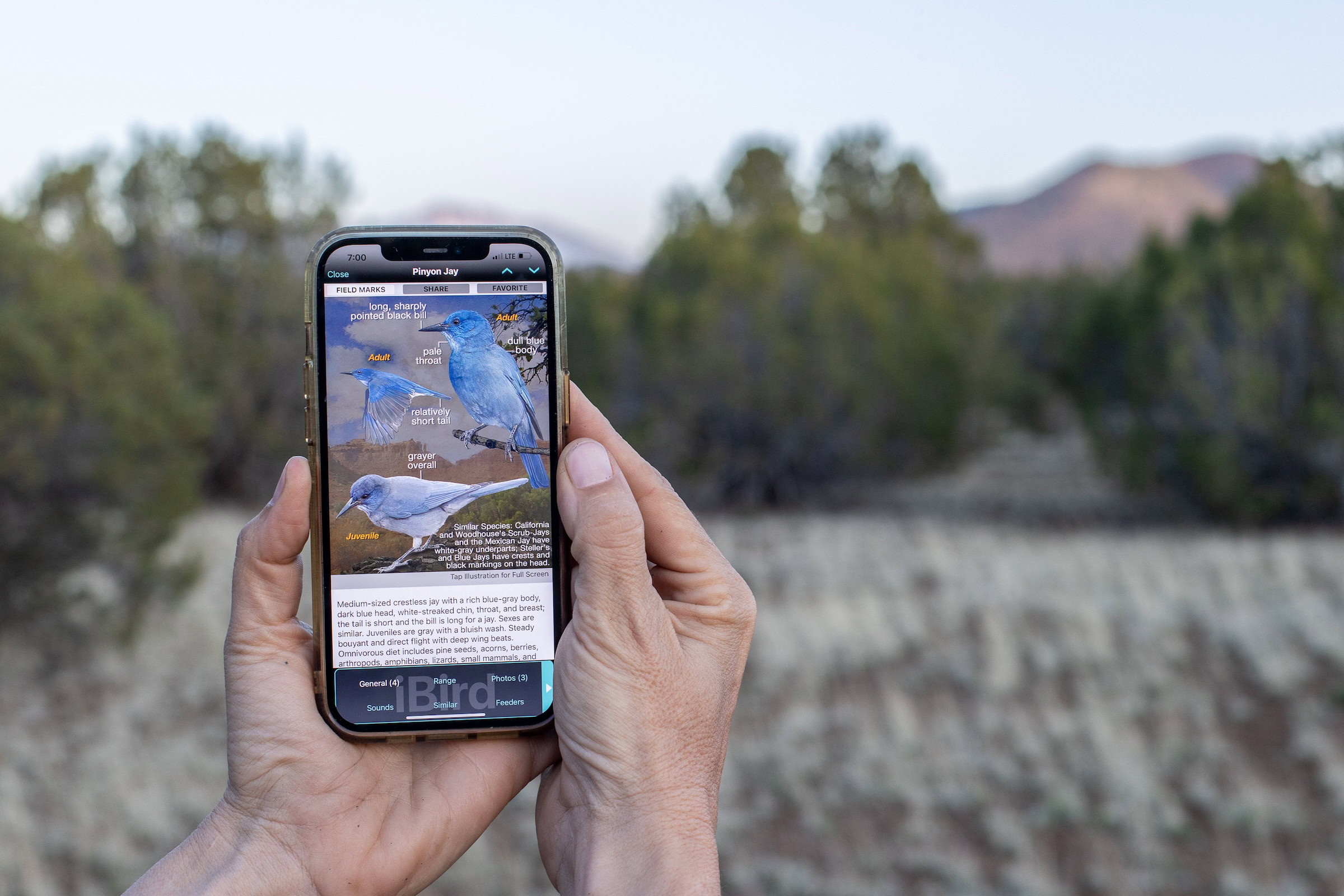
“We like to think of the increasing attention to pinyon jay conservation as a real opportunity to think about these large landscapes more holistically,” Boone says. “I think it’s safe to say, collectively, we understand a lot more about it than we did. But there’s still juice to squeeze out of that lemon.”
Even if scientists don’t quite understand the missing piece in the pinyon jay puzzle, efforts are nonetheless underway to save pockets of pinyon-juniper forests wherever the birds seem to be thriving. That necessarily starts with understanding where pinyon jays still live—a task that many community organizations are enthusiastically taking up to aid the work of scientists.
Audubon Society chapters in Nevada, Arizona, and New Mexico are using an app called Survey 123 to record pinyon jay sightings. The Grand Canyon Trust also launched a citizen science project with the eBird app, and has used the data to provide feedback to agencies on proposed pinyon-juniper removal projects. Greater awareness of pinyon jay presence has even helped halt a 30,000-acre project to chain and masticate trees and spread grass seed in Utah’s Grand Staircase-Escalante National Monument, for failing to consider how pinyon jays and other bird populations would be affected. If the Fish and Wildlife Service lists pinyon jays as threatened or endangered, community-collected data might also be used to identify critical habitat.
In Santa Fe County, Peggy Darr, Defenders of Wildlife’s New Mexico representative, launched a county-wide pilot project to alert landowners to take extra care of what’s generally seen as a hardy desert tree. Scattering mulch at a pinyon pine’s base to cool the surface temperature, surrounding them with straw wattles to slow runoff, skipping pesticides, and watering them might persuade the trees to produce seeds more often. It’s a small-scale effort, Darr concedes, but with pinyon jays declining as fast as they are, it’s time to try anything.
Audrey Kruse, community engagement director with the Grand Canyon Trust, fights entrenched state and federal practices to save clusters of old-growth pinyon and juniper trees, trying to change how an ecosystem that spans millions of acres is overseen one small project at a time.
And to boost public awareness of the plight of pinyon jays, Audubon Southwest partnered with a brewery in Albuquerque, New Mexico, and a meadery in Flagstaff, Arizona, to release signature brews both called “Oh Hey, Pinyon Jay.” These efforts, they all hope, will add up.
The community-collected data might also tease out a glimpse of our future landscape. Climate change is transforming the Southwest, so the question is becoming, where might pinyon jays seek habitat in the decades ahead, and how do people begin protecting those places now?
“What was doesn’t matter much anymore,” Darr says. “It’s more, what can it be moving forward in a new climate regime?”
Walking on a trail outside Santa Fe, Darr points out the remnants of dead pinyon pines scattering the dusty earth. The junipers, not much taller than we are, are still thick enough to obscure the arroyo below, but many of the mature pines have withered to bare, gray branches after recent drought. Still, there’s a pinyon jay colony nesting nearby, and perhaps because of it, pinyon seedlings are starting to emerge. The knee-high, tender green saplings often tuck under or weave into the branches of junipers, fully engulfed in the shade of the more drought-resistant “nurse” tree. Here, they’re not so much gaining ground as trying to reclaim it.
We sit next to a rare surviving pinyon, the air and ground palpably cooler in its shade, and look over the nesting colony. The females incubating nests wait silently through the warm spring afternoon. When the males return with bills full of nuts, the females will erupt into a noisy chorus, the birds passing nuts from bill to bill before settling back into silence. Sometimes Darr sits for hours, waiting to watch them return.
Hi, I’m Dave, the executive director of bioGraphic. (And that’s my dog, Finn.) Thanks for taking the time to read this story.
Stories like this simply don’t get produced without financial support from readers like you. bioGraphic is an independent non-profit—we’re not backed by a private company or owned by a billionaire. One-quarter of our budget comes directly from reader donations.
bioGraphic publishes environmental reporting that you can’t find anywhere else: deeply researched, trustworthy stories that are also beautiful and captivating to read. Right now, we need your help to raise $20,000 by October 2. Every dollar will go directly to more crucial reporting projects.
Around the world, governments are slashing funding for conservation and scientific research, placing even more ecosystems and wildlife at risk. At bioGraphic, we’re steadfastly shining a light on the threats to our planet’s incredible biodiversity. And we’re showcasing the hard work of people bravely taking action to protect at-risk species.
bioGraphic offers an antidote to apathy and doom-and-gloom news by revealing the wonders of the natural world and focusing on real solutions to big problems. When you finish a bioGraphic story, we want to leave you feeling informed, delighted, and inspired.
We don’t run ads or hide our stories behind a paywall. The readers who generously support bioGraphic allow our work to remain free for everyone.
Will you help us raise $20,000 by October 2?

Related Articles
Death by a Thousand Dams
Tens of thousands of small barriers hamper fish recovery in the northeastern United States. But while the demolition of big dams out west gets the most attention, a similar revolution is revitalizing northeastern streams and rivers—one tiny dam at a time.
The Unwilding of Patagonia’s Pollinators
In a region synonymous with wilderness, native bumblebees are being replaced by industrial worker bees—and ecosystems are paying the price.
The Corals That Shouldn’t Exist
Beneath Miami’s skyscrapers, a colony of corals defies expectations—and offers insight into other undersea urban ecosystems.
