
Slime Sense
A wildly variable group of single-celled organisms shows intelligent behavior.
Photograph by Andy Sands
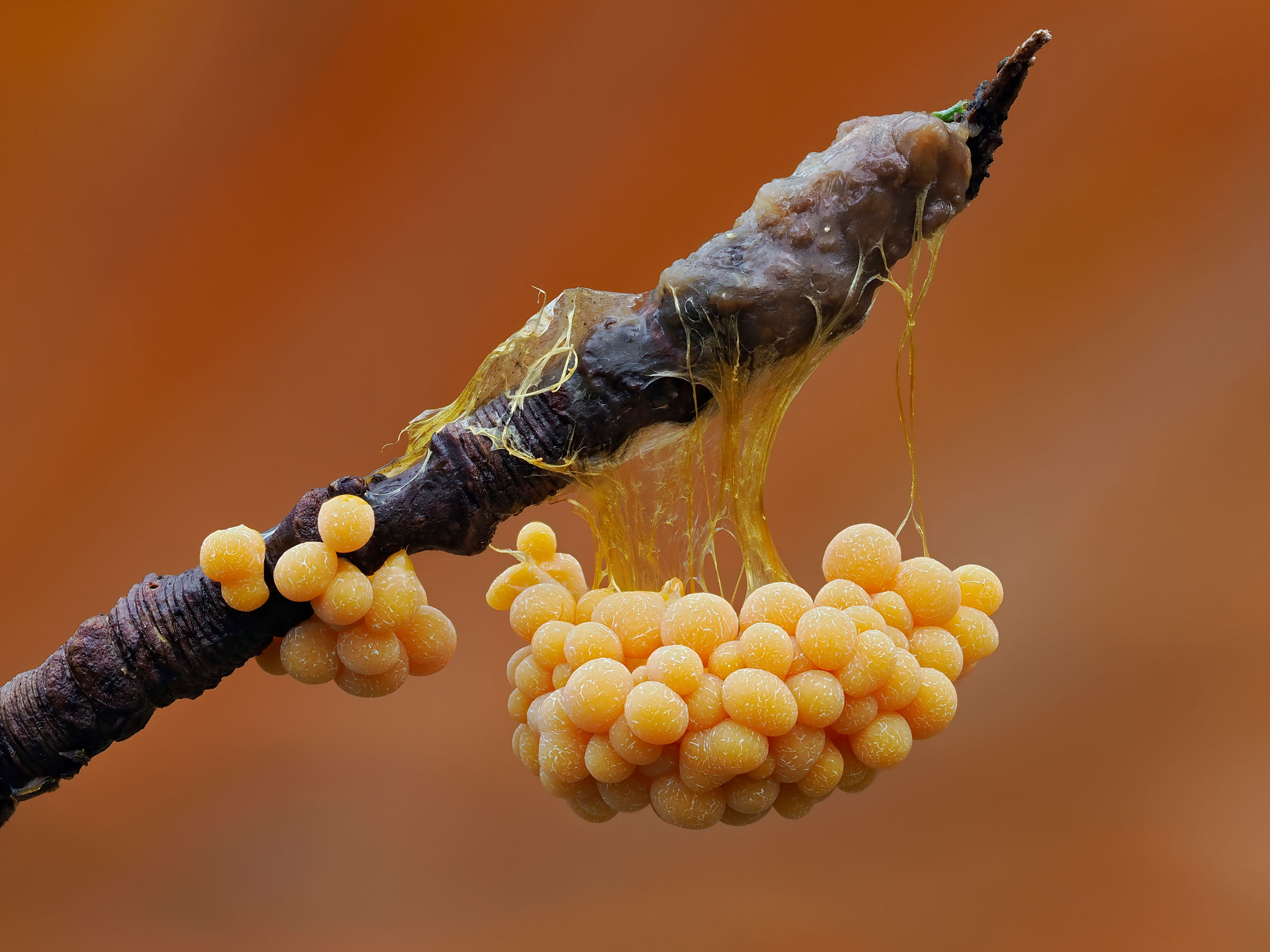
It’s easy to see why naturalists once grouped slime molds with fungi. The difficult-to-classify organisms reproduce with spores, just as fungi do. And to release those spores, slime molds grow fruiting bodies that are as dazzling in their variety as mushrooms. Some slime molds, like this Badhamia utricularis photographed by Andy Sands, look like tiny tangerines or juniper berries. Others resemble peacock-iridescent disco balls on stalks; or miniature red, gold, and orange popsicles; or clumps of brown hair. Most are miniscule. To find them, Sands, a U.K.-based photographer, advises budding slime-mold photographers to do as he does: “get a pair of strong reading glasses, a magnifying glass, and a torch, and crawl around under holly bushes for hours on end.”
But not every stage of the slime mold life cycle requires such close observation to find. Slime molds are protists—a mishmash of eukaryotic organisms that are not animals, plants, or fungi. Slime mold spores germinate to form amoeba-like or flagellated cells. These can merge into a zygote, which can then grow through mitosis into one giant, creeping cell with multiple nuclei, called a plasmodium. Depending on the species, a single plasmodium can cover an area of more than 10 square meters (108 square feet)—about the footprint of a small bedroom.
The many shapes and shades of slime molds—there are more than 900 species worldwide—have led to an equally arresting array of common names. Fuligo septica, for instance, forms a chunky, bright-yellow mass, which Indigenous peoples of Mexico have called “moon’s excrement.” Scholarly manuscripts from ancient China, meanwhile, describe what is likely the same species as “demon droppings.” Today, it is more widely referred to as “dog-vomit” or “scrambled-egg” slime mold. Other species have earned such charming sobriquets as “wolf’s milk,” “chocolate tube,” and “pretzel.” One Arkansas-based researcher had a friend suggest that the whole cryptic group would be much better described as “sublime molds.”
These remarkable creatures do more than rack up nicknames. They also challenge the conventional scientific wisdom that an organism must have a central nervous system to learn and to show intelligent behaviors. One well-studied species, the yellow Physarum polycephalum, can find the most efficient path to food through a maze. Various researchers have also placed little piles of food on flat maps of Tokyo, Canada, the U.K., and Spain and shown how Physarum navigate between hubs in ways that mirror those regions’ modern transportation networks or follow routes of comparable efficiency. In another experiment, researchers presented the species with various food mixtures. The Physarum specimens first explored each mixture, then consistently chose the one with the most ideal nutrient balance. In still other experiments, the organism used its own slime paths to remember where it had been. Physarum can also habituate to stimuli, such as a novel chemical, proceeding more cautiously and slowly across a surface where the chemical is present but learning to ignore it over time if repeated encounters lead to no ill effect. A habituated slime mold can even pass on what it has learned to another plasmodium by fusing with it.
Whether these experiments confirm that slime molds are sentient is hard to say, University of Sydney, Australia, researcher Tanya Latty told The Knowledge Archives in 2020. But it does call into question the need to sort all organisms into tidy categories. “Life,” says Latty, “doesn’t necessarily fit into the boxes we want it to.”

Hi, I’m Dave, the executive director of bioGraphic. (And that’s my dog, Finn.) Thanks for taking the time to read this story.
Stories like this simply don’t get produced without financial support from readers like you. bioGraphic is an independent non-profit—we’re not backed by a private company or owned by a billionaire. One-quarter of our budget comes directly from reader donations.
bioGraphic publishes environmental reporting that you can’t find anywhere else: deeply researched, trustworthy stories that are also beautiful and captivating to read. Right now, we need your help to raise $30,000 by October 2. Every dollar will go directly to more crucial reporting projects.
Around the world, governments are slashing funding for conservation and scientific research, placing even more ecosystems and wildlife at risk. At bioGraphic, we’re steadfastly shining a light on the threats to our planet’s incredible biodiversity. And we’re showcasing the hard work of people bravely taking action to protect at-risk species.
bioGraphic offers an antidote to apathy and doom-and-gloom news by revealing the wonders of the natural world and focusing on real solutions to big problems. When you finish a bioGraphic story, we want to leave you feeling informed, delighted, and inspired.
We don’t run ads or hide our stories behind a paywall. The readers who generously support bioGraphic allow our work to remain free for everyone.
We reached our goal, but there’s time left. Will you help us smash our original goal and reach a new goal of $30,000 by October 2?

Related Articles
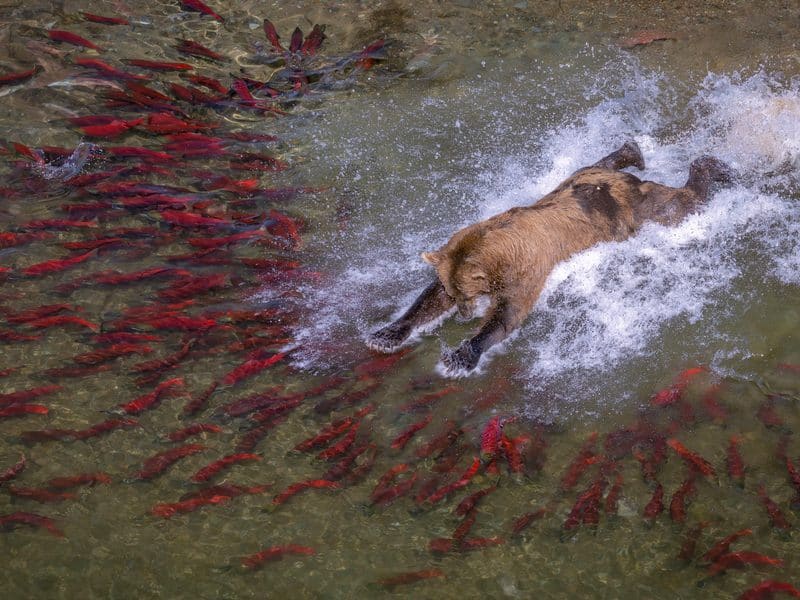
The Art of the Catch
To bulk up for winter hibernation, Alaska’s brown bears employ a range of techniques for snaring salmon.
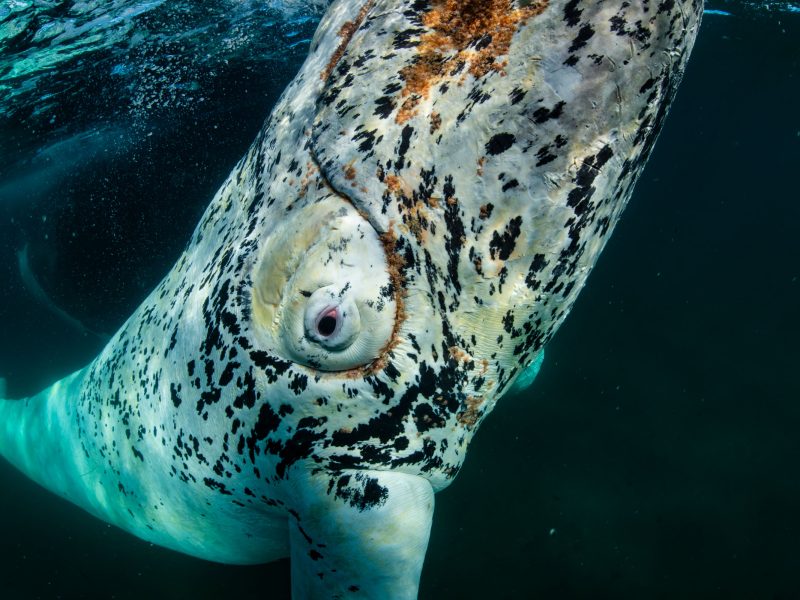
The Wonder of a Pale Whale
A curious calf with an atypical birthday suit is a good sign for southern right whales.
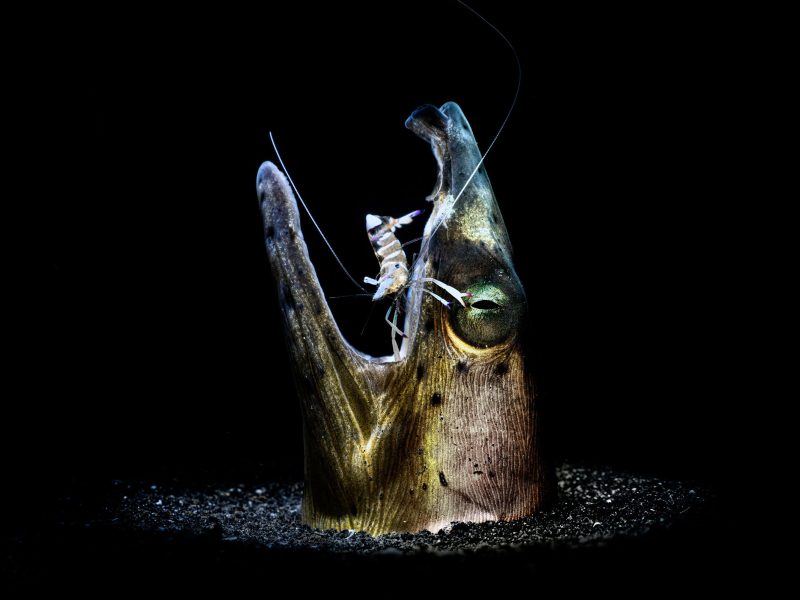
Saying “Ah!” at the Shrimp Spa
On coral reefs, an army of tiny cleaners eat their clients’ parasites, food particles, and dead skin, boosting biodiversity in the process.
