
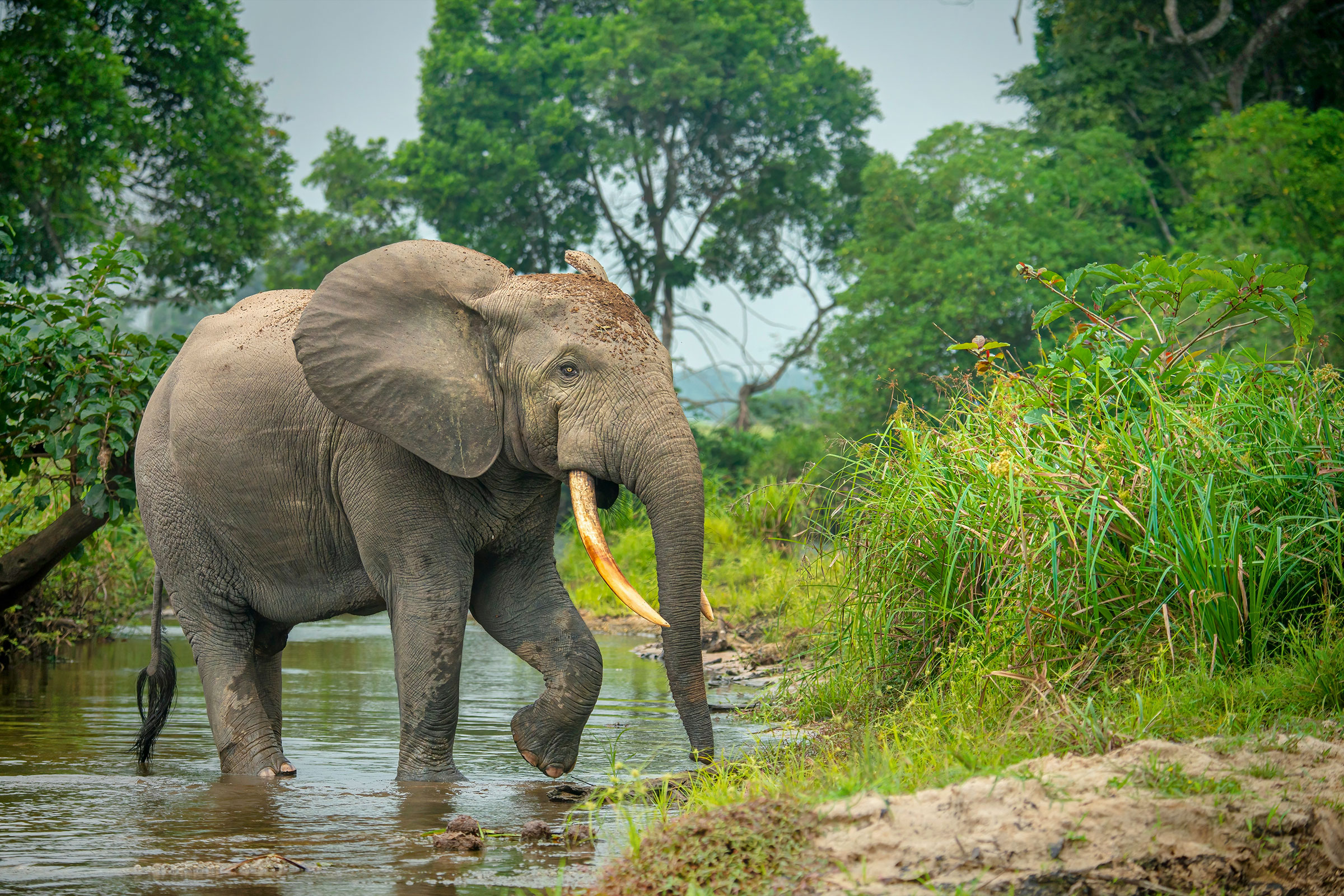
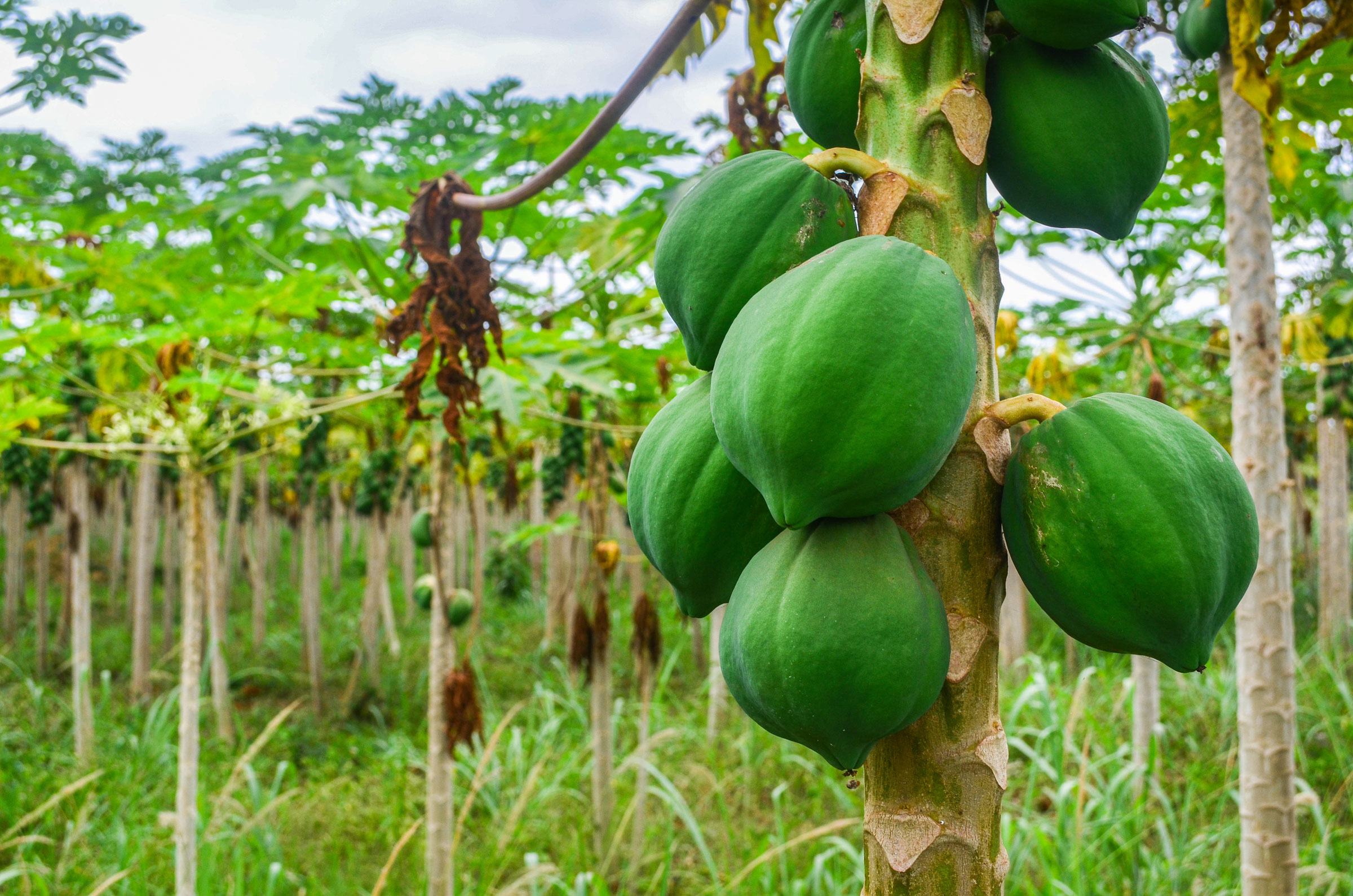
Many farmers across the western African nation of Gabon share the same grievance: waking up to trampled crops following nighttime raids by hungry forest elephants. But some elephants aren’t just after tasty snacks, as some observant farmers have noticed—the animals often seek out the stems and leaves of banana and papaya plants and leave the nutritious fruit broken on the ground. “That makes farmers even angrier, because they can’t understand why they just damage the fruits and don’t eat them,” says Steeve Ngama, a conservation scientist at Gabon’s National Center for Scientific and Technological Research in Libreville.
But why would elephants eschew the fruit? Forest elephants in Southeast Asia are known to eat certain plants when they’re ill as a kind of self-medication, and Ngama recalled research suggesting that banana and papaya leaves have medicinal properties. Could it be possible, he wondered, that Gabonese farms aren’t just buffets for local elephants but also pharmacies?
Together with other scientists in Gabon, Europe, and the United States, Ngama has now found evidence for this theory. The study, published in Ecological Solutions and Evidence, reports that African forest elephants (Loxodonta cyclotis) are more likely to seek out papaya and banana plants when they’re suffering from gut parasites.
In 2016 and 2017, Ngama worked with farmers to study crop-raiding elephants in several small villages in Monts de Cristal National Park, a rainforest-enveloped area near Gabon’s Atlantic coast. After the animals carried out their heists, Ngama would follow their trails and collect dung samples. He also gathered samples from plants the animals had nibbled on—including bamboo, costus herbs, ferns, ficus, banana, papaya, cassava, and palm. Later, scientists analyzed the roughly 90 dung samples in a lab for evidence of gut parasites such as worms. Having a parasitic infection, they concluded, made elephants 16 percent more likely to eat banana stems and leaves, and 25 percent more likely to nibble on papaya plants.
More research is needed to conclusively say that the crop-raiding behavior is medicinal in nature, says Elodie Freymann, a postdoc at Brown University in Rhode Island who studies self-medicating behavior among chimpanzees in Uganda. It’s possible that crop-raiding elephants are just more likely to carry parasites because they spend more time near people and livestock, for instance. That said, “I have no doubt elephants possess complex medicinal repertoires, and studies like this are an important step toward uncovering them,” Freymann adds.
Another uncertainty is what benefits papaya and banana plants specifically offer. The plants are known to contain parasite-fighting compounds; banana-leaf extract can kill the eggs of certain parasites in sheep, while the fluid inside papaya stems can help control gut parasites in chickens. As for how parasite-infected elephants would know that these plants might help them, ethnobiologist Jean-Marc Dubost points to experiments demonstrating that sick lambs can make associations between the healing effect of certain medicinal substances and their taste, and thus learn to seek out those plants during bouts of illness. Social creatures like elephants can pass on similar learned knowledge on to their relatives, says Dubost, who is affiliated with the Museum of Natural History in France.
For his part, Ngama hopes his findings can help mitigate conflicts between elephants and farmers. In Gabon, farmers often resort to violence to get rid of crop-raiding elephants, enlisting park managers or even poachers to kill the animals. But if elephants are given other sources of antiparasitic treatments—perhaps in the form of mineral salts—they might leave farmers’ crops alone, Ngama and his coauthors suggest.
On a more fundamental level, the study could also help shift farmers’ attitudes toward elephants, helping them perceive the pachyderms not as nuisances but as animals with valuable knowledge that could be used to improve human health. If elephants are indeed raiding crops for medicinal purposes, they could help scientists identify new treatments for human conditions. “They are really intelligent animals and we have a lot to learn from them,” Ngama says. “Then there will be more [efforts] to coexist with elephants.”
In places like Laos and Thailand, where domesticated wild elephants are tasked with heavy lifting for forestry and agriculture, traditional elephant handlers called mahouts have long taken note of the animals’ medicinal knowledge. “They say that the best way to cure a [sick] elephant is to release him into the forest, and he will find what he needs and recover within a few weeks,” Dubost says. Elephants eat the roots of the liana Harrisonia perforata when they have diarrhea, for example, or roots and stems of the vine Tinospora crispa when they’re listless and have poor appetite. Female elephants chew certain roots during pregnancy, postpartum, and nursing.
Dubost has learned that mahouts often use many of the same plants the elephants naturally use—in addition to human medicine—to treat elephant illnesses, as well as their own ailments. He suspects the mahouts got much of this knowledge from elephants as part of a cross-cultural exchange where both species work together to use the natural pharmacy around them. And studying the plants that animals turn to for their health has already revealed information that could help people: Scientists have identified new antimalarial compounds by observing the unusual consumption of leaves by chimpanzees, and research on the mosquito-repelling trees that chimps sleep in could also prove beneficial.
To that end, Ngama hopes to uncover other ways in which Gabon’s forest elephants use plants to weather sickness, from gut parasites to viruses that are particularly dangerous to humans, such as Ebola. “Maybe,” he says, “we can find out how elephants deal with Ebola and other outbreaks [that] humans, at the moment, are not able to deal with.”
Related Articles

How Much Plastic Does it Take to Kill a Seabird?
For the first time, researchers uncover how eating plastic trash may impact seabirds at the population level.
Shrimp Shell Slurry to the Rescue?
A new, multistep chemical process can turn bits of organic waste into “carbon-negative” fuel, food, and construction material.
The Lonely Race to Save Ukraine’s Past
In a country ravaged by war, Ukraine’s conservators are torn between protecting the country’s past and fighting for its future.
