
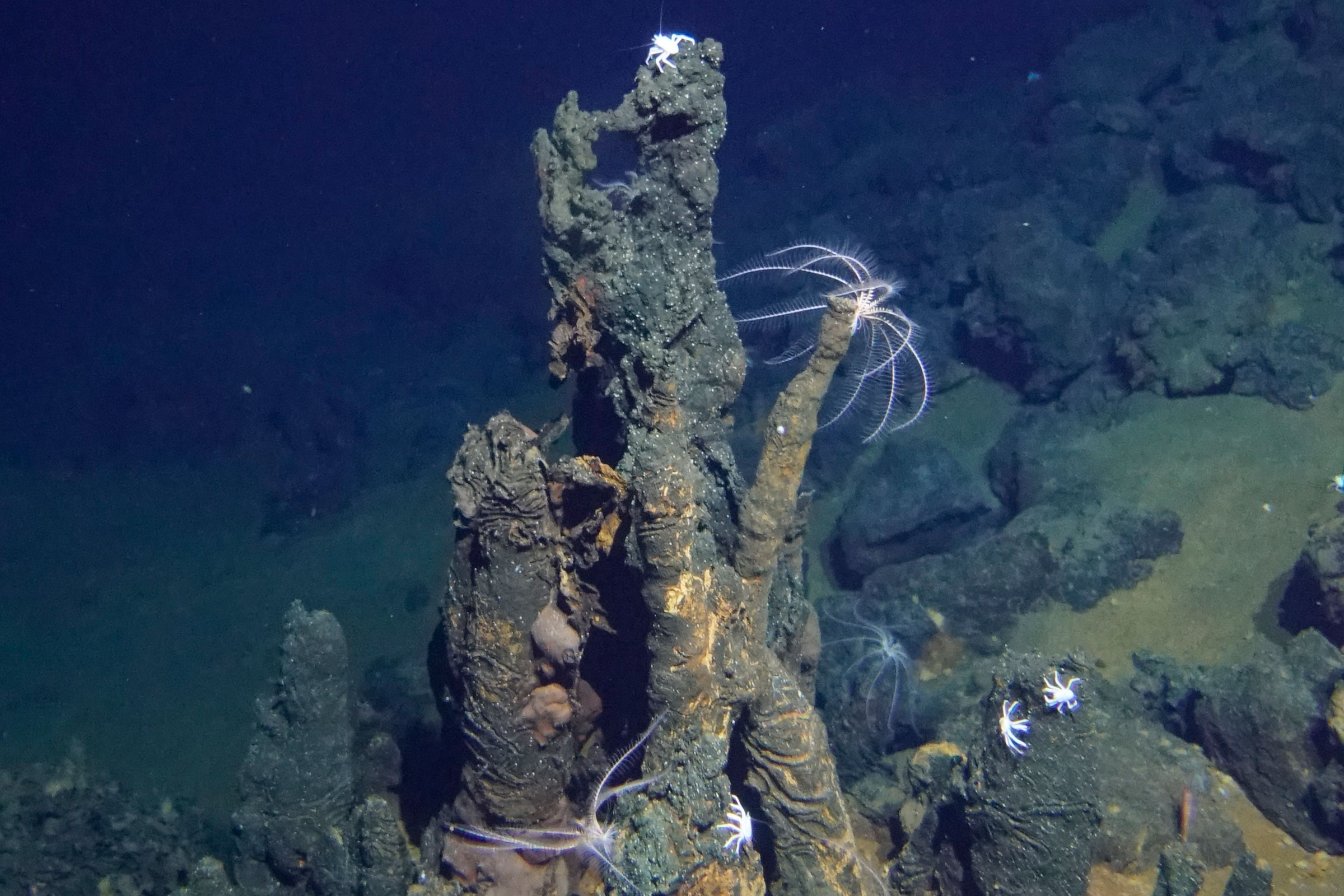
In the deep, inky blackness near the abyssal seafloor, the light from a remotely operated vehicle pierces the seemingly endless nothingness. Suddenly, a shrimp flickers in the light, followed by pale vent fish. Then, crabs appear, crawling along the rocky surface as an active hydrothermal vent spewing a billowing plume of dark water comes into view.
Hydrothermal vents are seafloor fissures where seawater enters the Earth’s crust, gets heated by magma to a scorching 370-or-so degrees Celsius (approximately 700 degrees Fahrenheit), and then comes shooting back out with a smoky color that comes from dissolved minerals. As the dissolved minerals harden, towering formations often rise above the fissures. These so-called chimneys can grow as fast as 30 centimeters a day, reaching heights of up to 60 meters (roughly 200 feet), though the taller chimneys are prone to collapse.
Before actually discovering them, scientists predicted hydrothermal vents’ existence because of otherwise-inexplicable heat they were detecting in the deep sea. In 1977, researchers took a ship out into the Pacific Ocean; roughly 640 kilometers (400 miles) off the coast of Ecuador, they descended in a submersible named Alvin to a suspected hydrothermal vent location. They made history—not only for finding hydrothermal vents, but for finding them covered in life. No one had expected such a seemingly inhospitable place to be teeming with life, and no biologists were even on the expedition. So, the team of geologists, geochemists, and geophysicists had to use a bottle of vodka they had on the ship to store specimens of the unusual clams, mussels, crabs, and tubeworms they found hiding in the deep.
Since then, all around the world, active deep-sea hydrothermal vents have been found to teem with eye-catching creatures, from hairy white yeti crabs to the famous red-tipped tubeworms. Now, though, new research shows that even inactive vents—which are no longer emitting hot, mineral-rich fluids—have been hiding remarkable ecosystems of their own.
Historically, scientists have spent more time studying hot hydrothermal vents than cold ones. Hot vents are easier to find, with heat that can be detected in the dark, cold depths. Inactive vents are often found near active vents as part of the same vent field. Though inactive vents have stopped emitting heat, they can retain their chimney formations, which may take thousands of years to collapse.
Scientists long assumed that cold vents, without the mineral-rich plumes that make active vents so mesmerizing, didn’t host unique lifeforms. The species they saw on them, including sponges and anemones, were also found elsewhere in the deep sea, suggesting that inactive vents were basically just rocks that common species sometimes landed on, rather than interesting ecosystems in their own right.
“It turns out that we just weren’t looking very closely,” says Jason Sylvan, a marine microbiologist at Texas A&M University.
On a research cruise with other scientists, Sylvan suggested taking a closer look: “I was obsessed with the inactive vents,” he recalls. So in early 2024, his colleagues scoured cold vents at a site known as Nine North, about 900 kilometers (560 miles) off Mexico’s southwest coast.
This vent field is on the East Pacific Rise, an underwater volcanic chain that traces the boundary between tectonic plates. Fields of hydrothermal vents often form at such volcanically active areas. The Nine North field is one of the world’s best studied, with many vents both hot and cold. An underwater eruption in 1991 drew scientific attention to the site, and the interest hasn’t cooled since. Still, its inactive vent ecosystems have long gone overlooked.
Sylvan’s colleagues dove to Nine North using Alvin, the same submersible from the 1977 hydrothermal vent discovery. They collected rock samples from cold vents there, and upon close examination discovered a thriving community of teensy animals living on them, many smaller than a millimeter across. These striking lifeforms, from shrimp-like creatures to spindly brittle stars to pale-shelled snails, seem to be uniquely associated with inactive vents.
Many of the small animals shelter in the vents’ deep rock crevasses, so they’re hard to find. Meanwhile, the animals on an inactive vent’s surface can look like unassuming white spots. The researchers vacuumed the lifeforms from the rocky surfaces and crevasses using a tool called a slurp sampler. They also collected rock samples and stored them in cold, filtered seawater. Then, in the ship’s lab, they searched the rocks, and used a fine mesh to sieve out any animals that may have fallen off.
Examining their findings through a microscope, the team discovered that most of the animals were tiny gastropods, often with delicate, pretty shells.
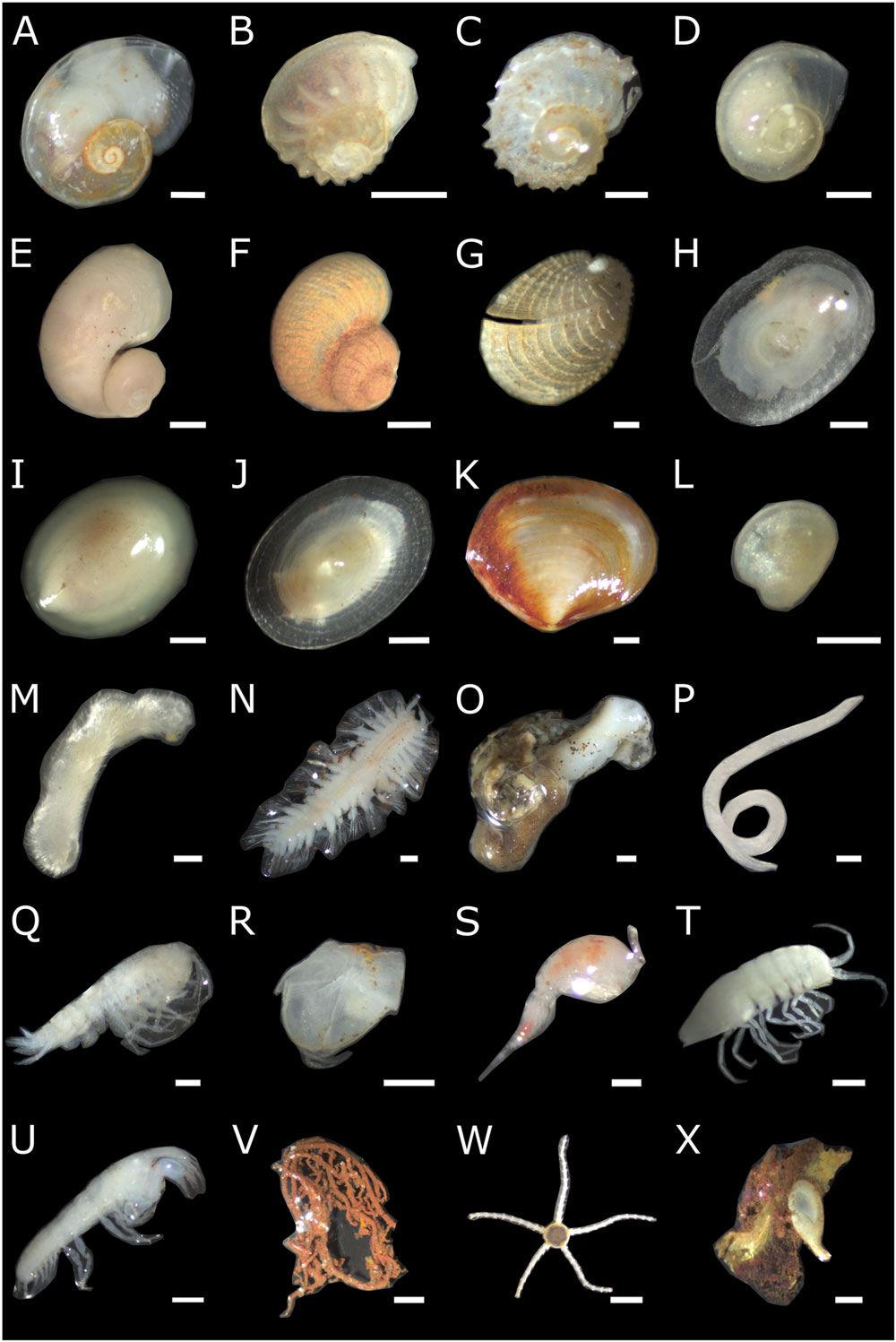
While it’s not yet clear exactly what sustains these creatures, there’s a good chance they’re eating microbes that live on the inactive vents. The microbes themselves are likely sustained by minerals from the rocky vent formations. Microbes on hot hydrothermal vents consume dissolved minerals in the vent plume, and scientists have previously found that microbes on inactive vents can consume solid rock for fuel.
At both hot and cold vents, the microbes then feed larger lifeforms. “All of this life is possible because the microbes are using this chemical energy that’s released from inner Earth to then produce biomass,” says Mirjam Perner, a geomicrobiologist at the German marine science institute GEOMAR who wasn’t involved in the research by Sylvan and his colleagues. These microbes are primary producers, organisms that form the foundation of the food web by turning nonliving material into sustenance. Plants, for example, are primary producers that use sunlight to grow, and in turn feed other lifeforms.
Recent research of hydrothermal vents at Nine North has actually shown that the level of primary productivity on cold, inactive vents is about the same as on hot, active ones. This is surprising, Sylvan says: “In biology, we tend to think of warm being faster and cold being slower.” Anyone with a refrigerator knows that microbes tend to grow a lot slower in the cold. Yet in the deep sea, in water that’s a frigid 2 to 4 degrees Celsius (36 to 49 degrees Fahrenheit), “which is like a refrigerator, basically, the rates of primary productivity were within the same order of magnitude” as at hot vents, says Sylvan.
Because of their similar primary productivity levels, it turns out that both hot and cold vents play an important role in sustaining the deep ocean environment. “These are big things that we didn’t really know were happening before,” says Sylvan.
Not to be outdone, Nine North’s hot vents have also revealed unexpected biodiversity. Scientists recently discovered a number of parasitic flatworms carrying out complex, multispecies life cycles on the active vents, where the parasites jump between hosts like snails, shrimp, and fish.
While scientists have been learning about active vent ecosystems since these geological features were first discovered, their full complexity is still emerging. Multi-host parasites may sound bad, but modern research suggests they’re actually indicators of ecosystem health: their presence implies unbroken food chains and high densities of life, which the parasites need to successfully move between species.
All these revelations have come from research in just the past few years. “In our field, [Nine North] is one of the best-studied sites, and we’re still making fundamental discoveries,” says Sylvan. Yet as ongoing explorations reveal the secrets of life on hydrothermal vents, the emerging deep-sea mining industry is presenting new risks.
As well as targeting polymetallic nodules on the seafloor and metal-rich crusts on underwater mountains, some would-be deep-sea miners are interested in excavating hydrothermal vent formations, which can contain valuable materials like gold, silver, and zinc. Inactive vents, with their lack of equipment-destroying heat, and apparent lack of unique life, long seemed both more feasible and more ethical to extract from.
Now, thanks to the discoveries by Sylvan and his colleagues, the argument for protecting all types of vents—and their weird and wonderful life—is growing. Mining hydrothermal vents, even inactive ones, could potentially lead to extinctions. As Perner says, “You’re taking the whole backbone of what the ecosystem is based on away. It’s like taking the foundation of a house away.” Yet since scientists still know relatively little about these ecosystems, they can’t predict the full ecological consequences of destroying them.
If hydrothermal vents are protected from mining, future research could further deepen our understanding of life on Earth. Scientists believe there’s far more to discover at Nine North, and lesser-studied vent sites likely hold even bigger surprises.
“What kinds of other unexplored biodiversity might be out there?” asks Sylvan. “That’s really exciting to me.”
Related Articles
Shrimp Shell Slurry to the Rescue?
A new, multistep chemical process can turn bits of organic waste into “carbon-negative” fuel, food, and construction material.
The Lonely Race to Save Ukraine’s Past
In a country ravaged by war, Ukraine’s conservators are torn between protecting the country’s past and fighting for its future.
No One Knows How to Handle Nurdle Spills
A year after a shipwreck flooded India’s beaches with tiny plastic pieces, scientists fear the environmental damage has just begun.