
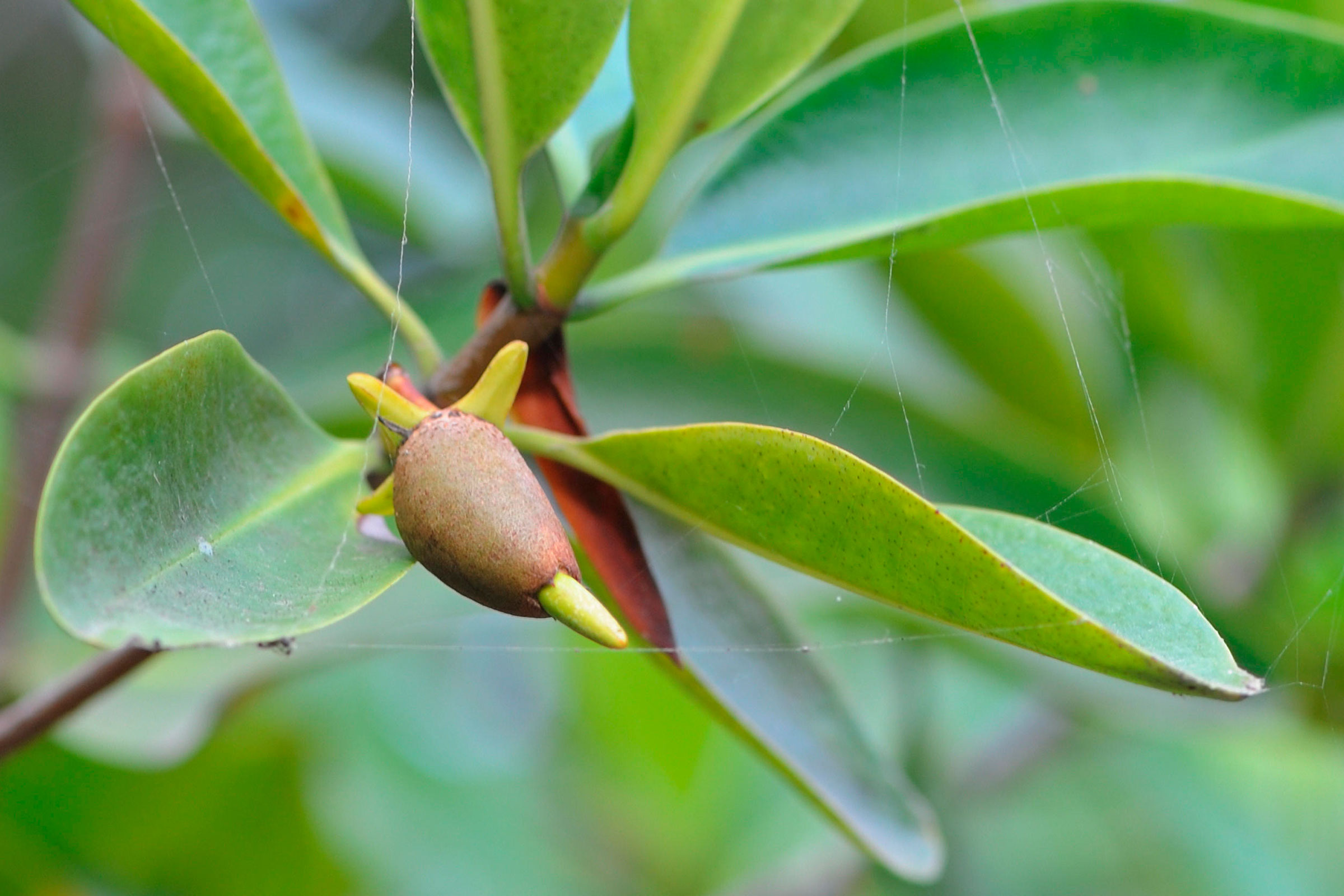
Typically, a seed’s number one job is to have patience. Before it grows into a new clover or pumpkin vine or oak tree or hydrangea, it has to wait. Only when conditions are just right will the seed sprout, which gives it the best chance of survival.
Yet for a few tree species, the seed’s job is different. It doesn’t wait. It starts growing right away, while still attached to its parent plant, and only separates later. Trees that do this are called viviparous, or live-bearing. It’s the same name scientists give to animals, such as humans, that birth live babies instead of laying eggs.
Despite the unexpectedness of this trait, researchers studying the genetics of viviparous trees recently showed that the pathway to their evolution might have been surprisingly simple.
While viviparity is rare among trees in general, it’s common among the mangroves, roughly 80 species that live on warm coastlines around the world. These trees are already unusual, as they absorb water that’s up to 100 times saltier than what most plants can tolerate.
A live-birthed baby mangrove doesn’t look like a chubby infant, or like a miniature adult mangrove. Instead, it’s like a string bean with a bulbous cap, topped by a little crown of roots. The babies hang from their parent tree in clusters, and when they reach a certain stage of development they drop straight down into the mud or sand below, says Yingjia Shen, a researcher at China’s Xiamen University.
If the tide is out when the baby mangroves fall, their roots grow rapidly, Shen says, with the plants starting to take hold within a few hours of hitting the ground. In other cases, though, the young plants may take a journey. Baby mangroves are buoyant, and “those that fail to root in the mud can drift in the ocean currents for several months,” Shen says, “potentially reaching coastlines thousands of kilometers away and taking root there.”
As with live birth in animals, developing while still attached to a parent helps protect the vulnerable seedling from the stressors of life. After all, the coastal environments that mangroves call home are rife with salt, intermittent flooding, and intense sun. The tactic also lets the tree put more time and energy into the baby plant. Those advantages may be why about half of the world’s mangrove species are viviparous.
To learn how mangroves became that way, Shen and his colleagues sequenced the genomes of two live-bearing species, as well as a closely related tree that lives inland and has normal seeds.
The team’s genetic sleuthing revealed that viviparous mangroves are either missing genes in a family called Delay of Germination-1, or DOG1, or they have a malfunctioning copy of the cellular info. Ordinarily, DOG1 genes prevent seeds from sprouting prematurely—they’re responsible for that patient period that most seeds have. But with their DOG1 genes either lost or broken, viviparous mangrove seeds sprout right away.
“It is very rare for a single gene change to have such a significant effect,” Shen says. Scientists still don’t know whether, or how, other genes may contribute to live-bearing mangroves. But based on their research so far, Shen and his colleagues “believe that viviparity in mangroves may not be a very complex trait, but rather a malfunction in the seed dormancy switch.”
Suhua Shi, who studies the evolution of mangroves at Sun Yat-sen University in China and was not involved in the recent research, wrote in an invited commentary in the scientific journal Current Biology that “this pioneering work raises more critical questions on mangrove evolution than it has resolved.”
However—and whenever—live-bearing mangroves lost their DOG1 genes, the tweak was a winning one. Of all the mangroves on Earth, viviparous species have the widest distributions, Shi writes.
For most terrestrial plants, non-dormant seeds would be a burden, Shen says. But for live-bearing mangroves, a little impatience goes a long way.
Hi, I’m Dave, the executive director of bioGraphic. (And that’s my dog, Finn.) Thanks for taking the time to read this story.
Stories like this simply don’t get produced without financial support from readers like you. bioGraphic is not backed by a private company or owned by a billionaire. It’s an independent, nonprofit magazine. And one-quarter of our annual budget comes directly from reader donations.
We need your support more than ever, as governments slash funding for conservation and scientific research, placing even more ecosystems and wildlife at risk around the world. At bioGraphic, we’re steadfastly shining a light on the threats to our planet’s incredible biodiversity. And we’re showcasing the hard work of people bravely taking action to protect at-risk species.
bioGraphic publishes environmental reporting that you can’t find anywhere else: deeply researched, trustworthy stories that are also beautiful and captivating to read. We offer an antidote to reader apathy and doom-and-gloom news by revealing the wonders of the natural world and focusing on real solutions to big problems. When you finish a bioGraphic story, we want to leave you feeling informed, delighted, and inspired.
We don’t run ads or hide our stories behind a paywall. The readers who generously support bioGraphic allow our work to remain free for everyone.
Will you help us keep telling these crucial stories?

Author

Related Articles
The Curious Connection Between Bacteria, Seagrass, and Carbon
New research shows that seagrass depends on the bacteria around it—and that the antibiotics entering our oceans could disrupt that relationship.
Trees as Public Health Infrastructure
New research shows that meeting tree canopy goals could prevent more than 67,000 premature deaths in the United States.
A Mite on a Bee on a Ship on the Sea Spells Trouble
Pollinator pathogens are spreading through international trade, threatening both agriculture and wild ecosystems.