
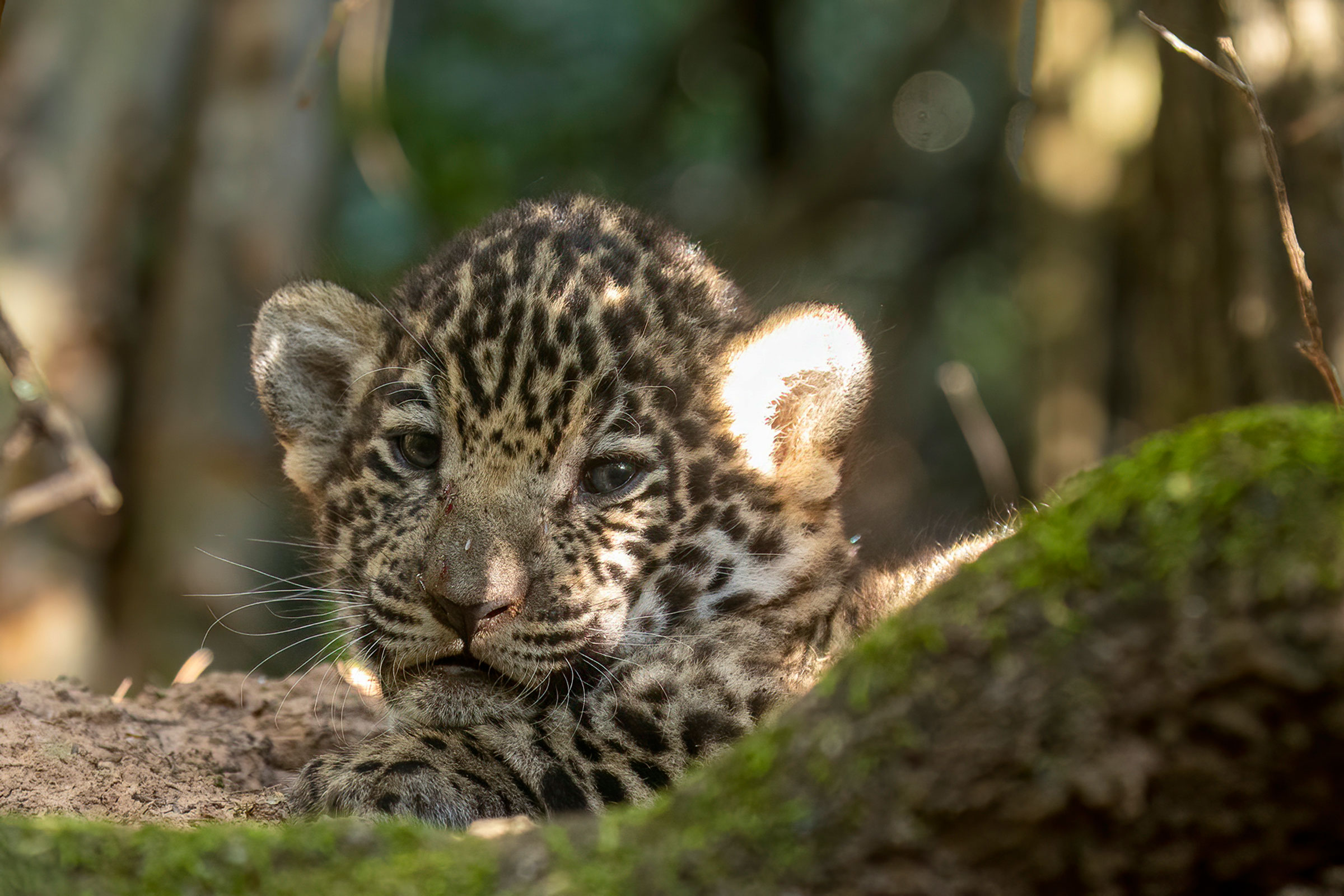
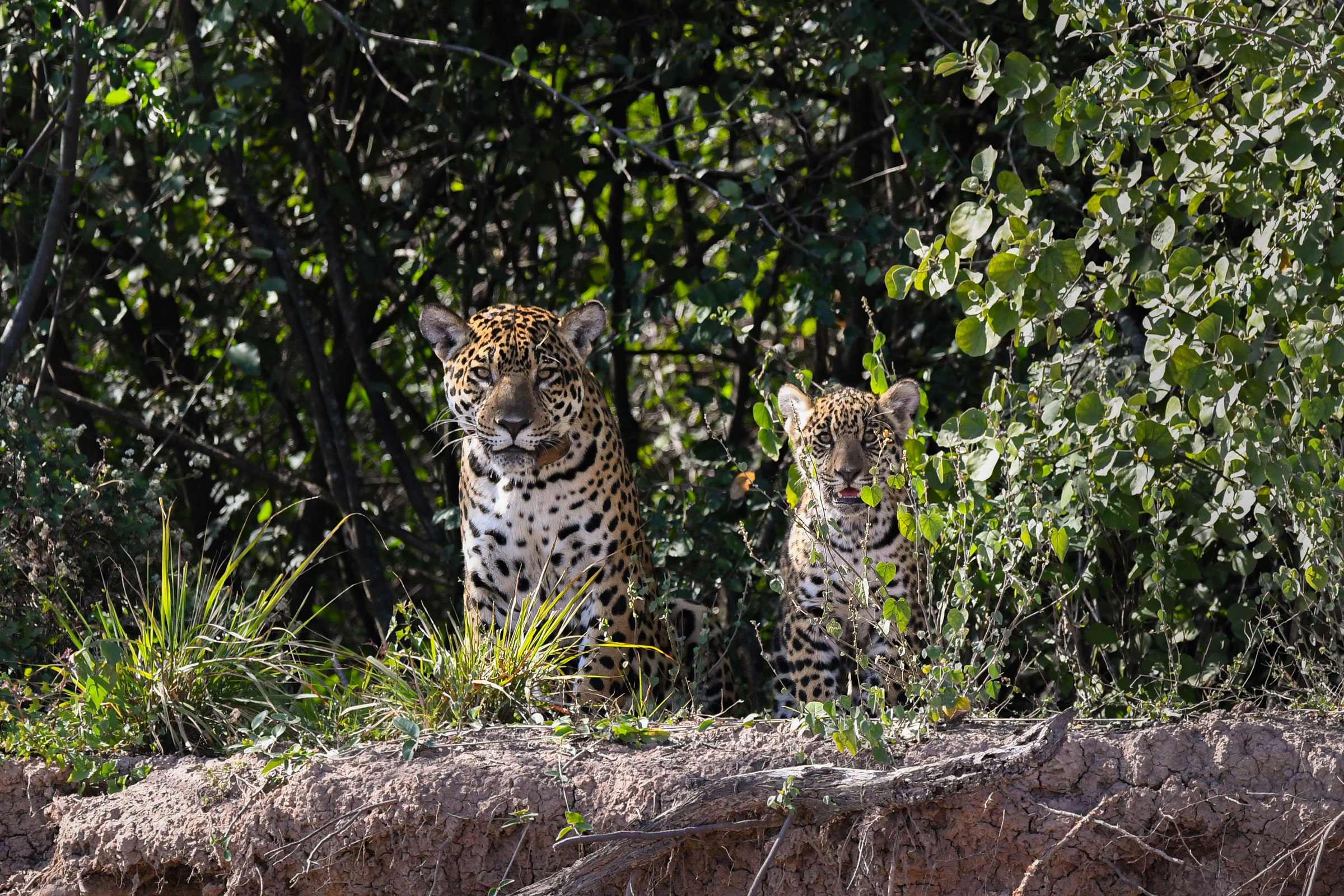
The first glimpse lasted only a few seconds. Darío Soraires, a wildlife tour guide, was sailing up the Bermejo River in northern Argentina when he saw them: two jaguars lying in a ravine. He quickly flagged his colleague, Pablo Luna. But by the time Luna lifted his camera and got the pair in view, one of the jaguars—a cub—had disappeared into the thick brush.
Undeterred, Soraires steered his boat toward the shore. A few moments later, the cub popped up again. This time, Luna was ready. He snapped a shot of the jaguar cub standing next to its mother—proof that, for what was likely the first time in at least 30 years, a wild jaguar (Panthera onca) had been born in Argentina’s slice of the expansive Gran Chaco Forest, South America’s second largest forest.
Known as yaguaretés in the Indigenous Guaraní language, jaguars are part of a larger rewilding project in the Argentine Gran Chaco, which has been impacted by decades of mining, ranching, farming, and illegal logging. Since 2019, the nonprofit Fundación Rewilding Argentina has been working to reintroduce the species near El Impenetrable National Park, rebuilding from an estimated remnant population of just 20 individuals. In 2024, the team released a female jaguar, Nalá, that had been born in captivity. The team was tracking her movements using a satellite collar when, in 2025, they noticed she had started lingering in the same spot, returning there day after day. It was a sign that she had probably given birth, but no one had actually seen the new cub.
“I wanted to be the first,” Soraires says.
Born and raised in the rural area surrounding El Impenetrable, Soraires has been involved in Rewilding Argentina’s jaguar reintroduction effort from the beginning. He first worked in construction and maintenance in the park and four years ago became a wildlife guide.
“My grandparents used to tell me that, back in their time, it was quite common to see yaguaretés,” Soraires says. The reintroduced mother and her cub, meanwhile, were the first Soraires had ever seen in the wild.
A few weeks later, another piece of good news: A different female released by Rewilding Argentina had also had a cub.
To Verónica Quiroga, a jaguar specialist with Argentina’s National Scientific and Technical Research Council, the birth of these jaguar cubs is “extremely hopeful” and “a good beginning” for the population’s recovery.
Nalá’s new cub is more than a symbolic victory. Her reproductive success is the latest result of a concerted conservation effort that began nearly seven years ago. And it all started with a wild jaguar—a male known as Qaramta.
In 2019, no one inside El Impenetrable had seen a jaguar for years when staff spotted the tracks of a male yaguareté along the banks of the Bermejo River. Young male jaguars can walk thousands of kilometers looking for females, and Qaramta probably would have continued on his way had Rewilding Argentina not raced to intervene.
Within two weeks, the NGO brought a female jaguar from another reintroduction project at Argentina’s Iberá National Park to an enclosure inside El Impenetrable, hoping to catch the male’s attention and keep him in the area. It worked. The female enticed Qaramta to approach the enclosure, where the Rewilding Argentina team managed to fit him with a monitoring collar. The female—too old to breed—was returned to her home in Iberá. Then the NGO brought in a younger female named Tania.
Tania and Qaramta hit it off immediately. Nearly every day, the male jaguar would spend hours outside the enclosure that Soraires had helped build, brushing his head and body against Tania’s through the mesh and grunting softly at her. In 2020, after almost a year of courtship, the Rewilding Argentina team opened the gate, allowing Qaramta into the enclosure.
“It was the first crossing between a female in captivity and a wild male of a large feline in the world,” says Débora Abregú, a conservation coordinator at the Rewilding Argentina field station in El Impenetrable. “We didn’t know what was going to happen.”
The jaguars spent four days together before Qaramta returned to the wild. Three months later, Nalá was born.
Growing up inside the 1.5-hectare (3.7-acre) nature enclosure, Nalá learned to hunt alongside her mother. Abregú and the team would bring in live prey, including capybaras and caimans. Tania would lead the hunt and let Nalá finish the job. After four years, Nalá was released to the wild, while Tania returned to captive life in Iberá.
By then, word had gotten around among male jaguars that El Impenetrable was the place to be. The Rewilding Argentina team found two more males lured in by the new females and fitted them with tracking collars. Based on the tracking data, the team thinks one of these two males mated with Nalá to produce her new cub.
Soraires says that when he was a child, his grandparents told him stories about yaguaretés. The animals sounded aggressive and frightening. Today, he no longer sees them that way. And Rewilding Argentina is working to help others have a similar change in perspective.
Alongside their direct conservation efforts of capturing, feeding, training, and monitoring wild jaguars and other local species, Abregú says Rewilding Argentina is working with the local community to improve its relationship with yaguaretés. This includes teaching farmers livestock management techniques—such as how to install and use electric fences to reduce conflict and retributive hunting—as well as initiatives designed to help children forge appreciation for the animals, like putting on puppet shows starring Tania and Qaramta in local schools.
Indeed, it was the community who chose the jaguars’ names. Qaramta, for example, means “hard to destroy.” And locals dubbed the new cub Bermejo, for the river on whose banks he was first seen.
Related Articles
How Much Plastic Does it Take to Kill a Seabird?
For the first time, researchers uncover how eating plastic trash may impact seabirds at the population level.
Shrimp Shell Slurry to the Rescue?
A new, multistep chemical process can turn bits of organic waste into “carbon-negative” fuel, food, and construction material.
The Lonely Race to Save Ukraine’s Past
In a country ravaged by war, Ukraine’s conservators are torn between protecting the country’s past and fighting for its future.
