
Glowing from Within
With more scientists and artists turning their attention to bioluminescence, new information about glowing fungi is coming to light.
Photograph by Guy Edwardes
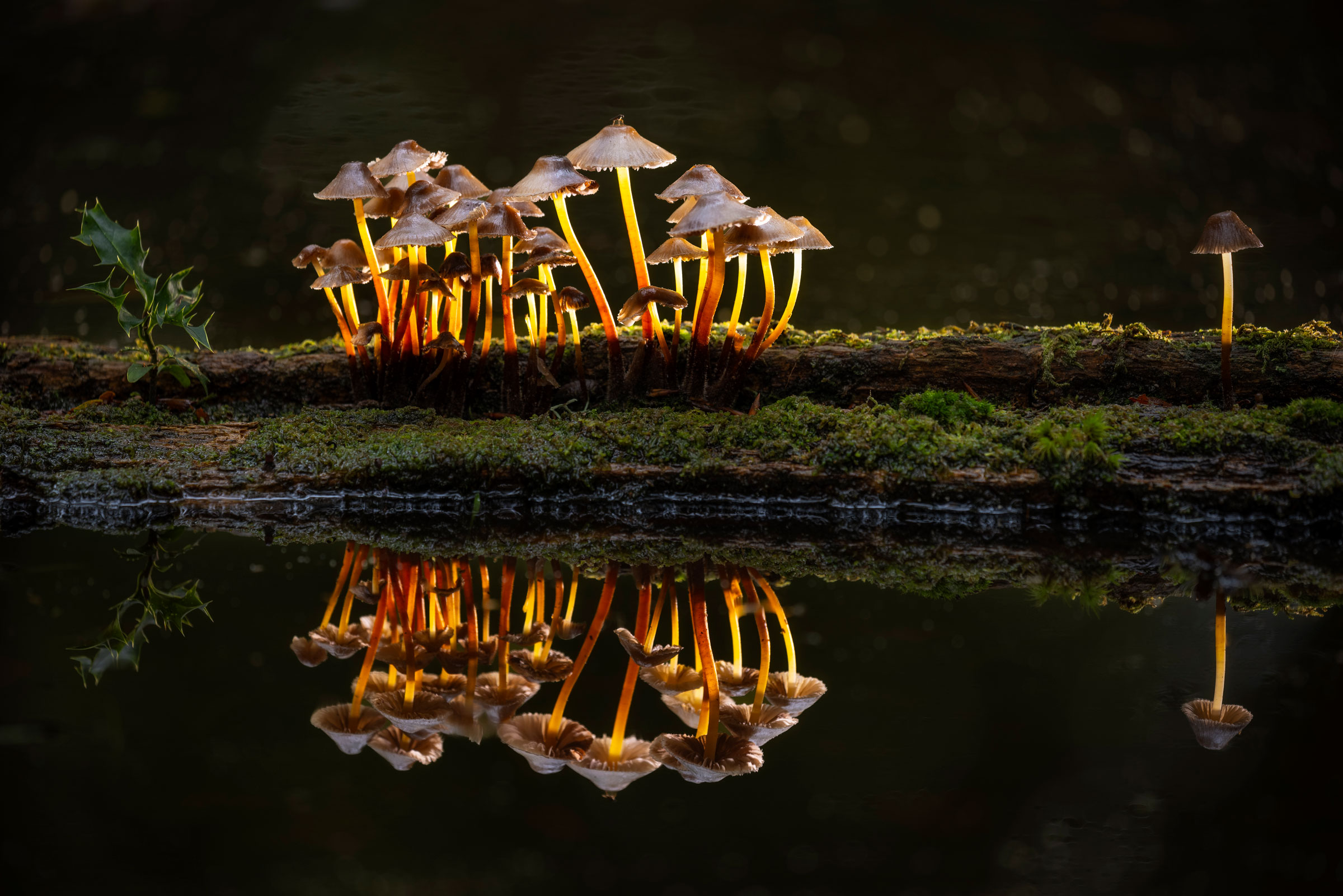
In an English woodland, a cluster of saffrondrop bonnet mushrooms is reflected in a puddle. Their golden gleam comes from beyond—cast by low-angle November sunlight—yet the fungi may be illuminated from within, too. Saffrondrop bonnets (Mycena crocata) are one of 125 or so species from the fungi kingdom known to produce their own light.
That saffrondrop bonnets luminesce was only discovered recently. In 2017, Swiss artists Heidy Baggenstos and Andreas Rudolf found what they thought was a species of mushroom known to be bioluminescent. They brought the specimens back to their studio in Zurich and photographed them with a 240-second exposure, revealing an ethereal, greenish light barely visible to the naked eye. But when the mushrooms oozed saffron-red sap—a telltale sign of saffrondrop bonnets—the duo realized they had documented bioluminescence in M. crocata, a species not previously known to glow. They teamed up with mycologist Renate Heinzelmann of the Swiss Federal Institute for Forest, Snow, and Landscape Research WSL, who used lab experiments and genomic sequencing to confirm the finding.
The resulting research, published in the journal Mycoscience in 2024, also shows that because M. crocata usually grows near hardwood trees, even wood interlaced with strands of fungi radiates green light.
While glow-in-the-dark flora and fungi may seem like science fiction, humans have been fascinated by them for millennia. Aristotle wrote about bioluminescent mushrooms some 2,400 years ago, and people in Indonesia and India sometimes use glowing fungi as natural flashlights to navigate dark forests. The phrase hikari-matsu has been used in Japan since at least the 18th century to describe pine trees lit with luminous fungi.
Still, many mycological mysteries remain. Some mushrooms only light up at night, while others emit light around the clock. At least one widely-distributed species of fungi has been found to glow in one location but not another. And there may be multiple reasons why mushrooms glow. Some scientists theorize that bioluminescence could be a metabolic by-product with no real purpose; others think it’s a protective measure, attracting predators that effectively guard the fungi from mushroom-munching bugs. Or perhaps the light aids in reproduction, calling in beetles, flies, and other insects that carry fungal spores. M. crocata releases its spores to the wind, though, so it doesn’t need help from insects. Why it glows, then, is entirely unclear.
Yet with scientists—and artists—increasingly turning their attention to fungal bioluminescence, new information will almost certainly come to light. Less than 1 percent of the planet’s 14,000 or so identified mushroom species are known to luminesce, but the actual figure could be much higher, given that some mushrooms only glow underground, and human vision can’t always detect mushrooms’ glow without help. At least 40 new species of bioluminescent fungi have been identified in the past decade alone, and Heinzelmann thinks many more will be found, particularly within the Mycena family.
“As bioluminescence is considered to be an ancestral trait,” she says, “non-bioluminescent Mycena species must either have lost their luminous ability, or it has not yet been discovered.” In many cases, she suspects the latter is true.

Related Articles
The Wonder of a Pale Whale
A curious calf with an atypical birthday suit is a good sign for southern right whales.
Saying “Ah!” at the Shrimp Spa
On coral reefs, an army of tiny cleaners eat their clients’ parasites, food particles, and dead skin, boosting biodiversity in the process.
Friends or Foes?
A flatworm and a sea squirt mingle in the tropical waters of West Papua, offering a glimpse into the complexity of interspecies relationships.
