
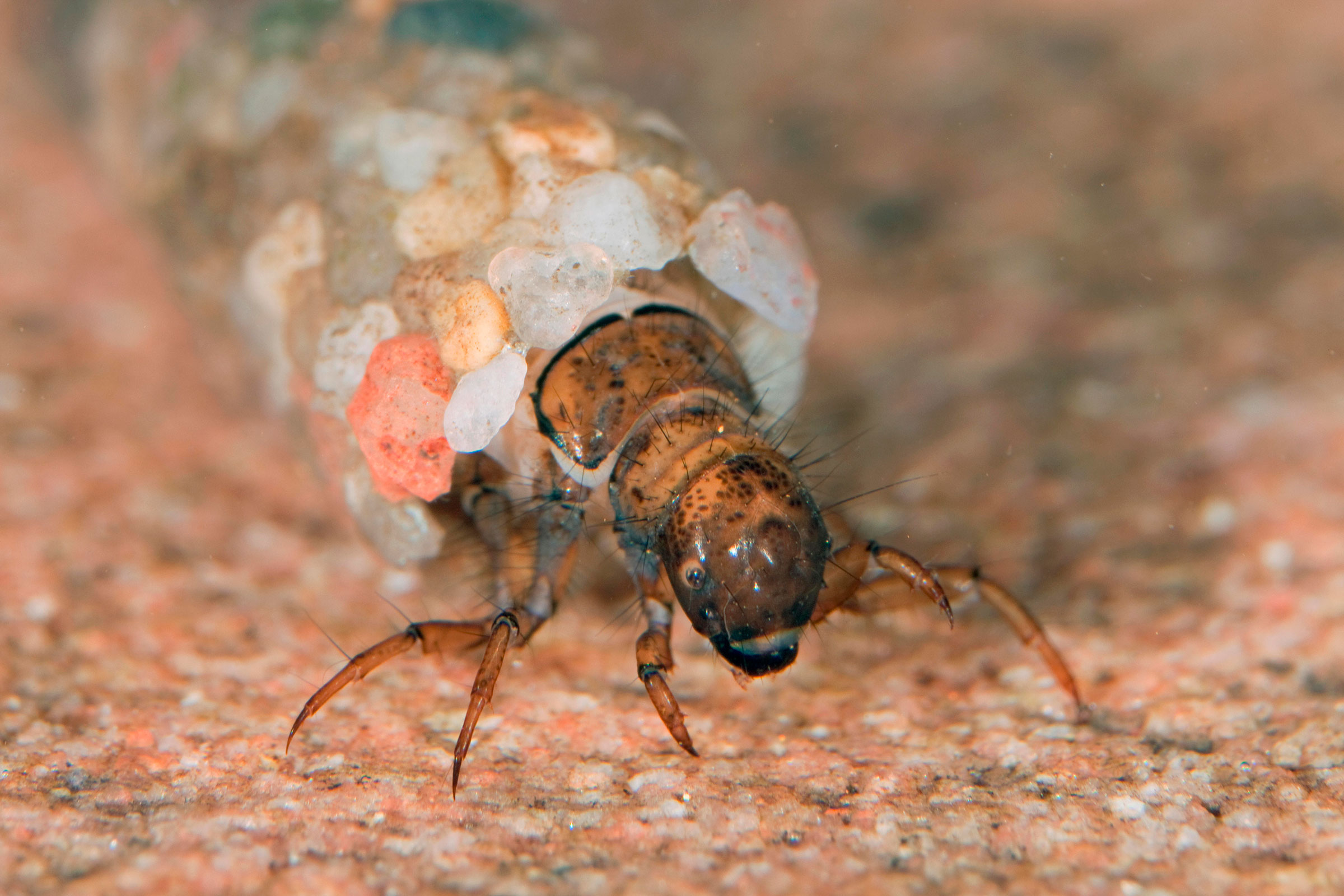
In the 1980s, French artist Hubert Duprat collaborated with an insect.
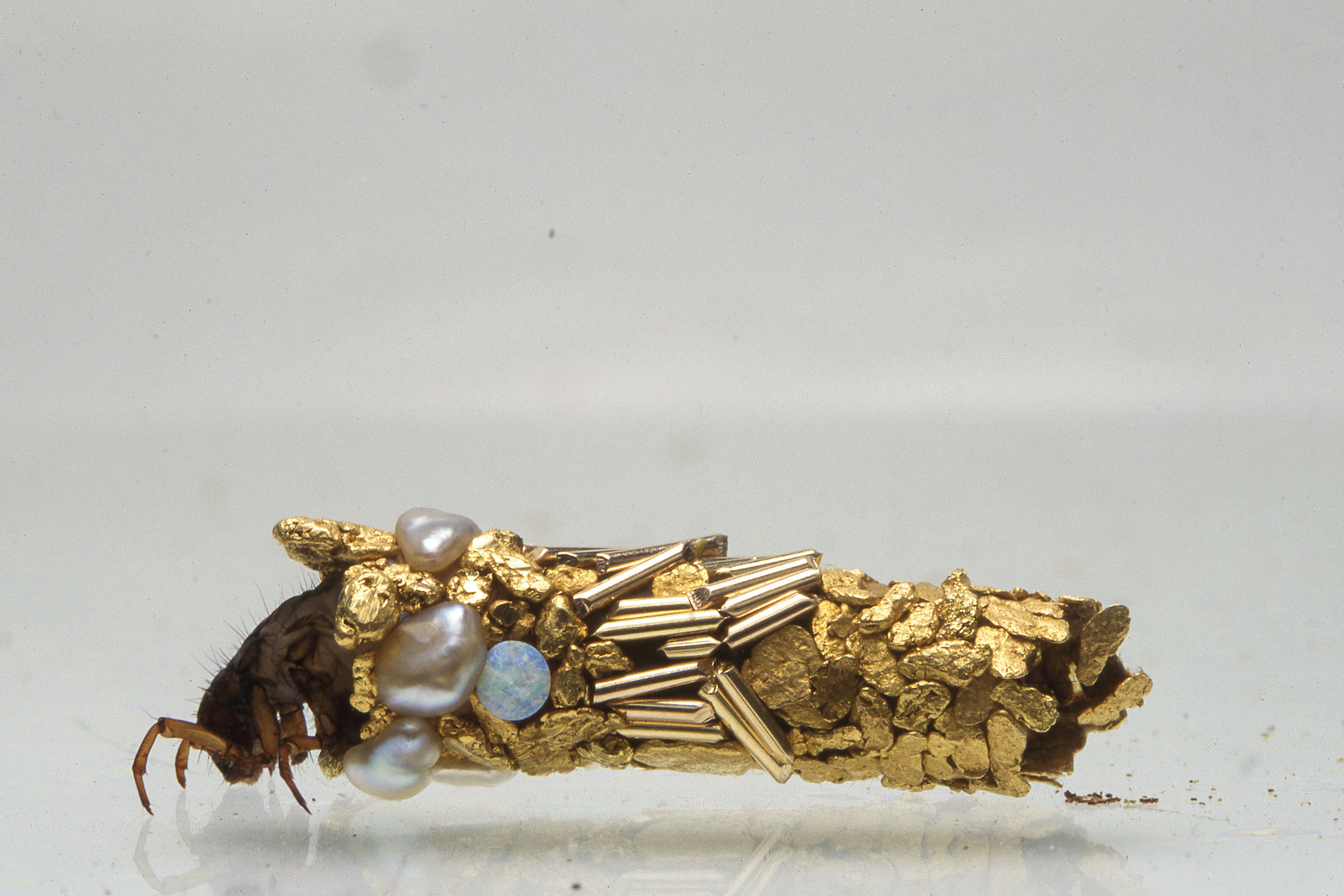
Duprat lined an aquarium tank with gold flakes, diamonds, and pearls. Then he added caddisfly larvae and sat back to watch them work.
Caddisflies (order Trichoptera) are nature’s aquatic collagists. They live most of their lives as larvae on the beds of rivers and streams before emerging as winged insects and briefly taking flight. As larvae, caddisflies craft tiny apartments of sand, pebbles, and bits of wood, mortaring them together with a silk-like material they secrete from their mouths. These cases, which camouflage and protect the juvenile insects inside and provide ballast in strong current, are remarkable little creations that can resemble a purse, a saddle, or a tube.
In Duprat’s aquarium, each caddisfly larva slowly built itself a sparkling, jewel-encrusted case. Today these “sculptures” reside in prestigious collections like those of the Centre Pompidou in Paris, France.
Duprat’s human-insect collaboration had long intrigued Auke-Florian Hiemstra, now a doctoral candidate at Leiden University in the Netherlands who studies animal architecture. Hiemstra has a particular interest in how animals incorporate nonnatural materials into their creations, and he wondered: If a caddisfly case is a snapshot of the building materials available at a moment in time, could those cases also tell us about the historical presence of microplastics in streams?
Humans had produced nearly 500 million metric tons of plastic by 2022, a figure that’s predicted to surge to 25 billion metric tons by 2050. As they break down, microplastics (generally defined as bits of plastic smaller than 5 millimeters, or the diameter of a pencil eraser) blanket the Earth. “They are in the air, in the rain, in the deep sea. They’re in our brains; they’re in our hearts,” says Hiemstra. “It’s impossible to avoid microplastics nowadays. But where did it start, and how did it start? There’s almost no evidence of the history of this pollutant.”
What’s more, most studies of microplastics in the environment have looked at their impact on the ocean—and the results are worrisome. Microplastics can contain thousands of chemicals, including compounds linked to cancer, neurotoxicity, and developmental toxicity. Studies have found that exposure to microplastics can harm the process of photosynthesis in some phytoplankton and reduce feeding in zooplankton—shifts that could reverberate through the food web.
In fresh water, researchers in 2018 found the first evidence of microplastics in caddisfly cases in polluted waterways in Spain and in England. But plastics have been widely used since the 1950s. At what point did they begin infiltrating the animal world?
To find out, Hiemstra and his colleagues scoured hundreds of drawers containing caddisfly cases at Leiden’s Naturalis Biodiversity Center, a natural history collection that Hiemstra is affiliated with. Then they used a stereomicroscope to search for odd or unnatural materials.
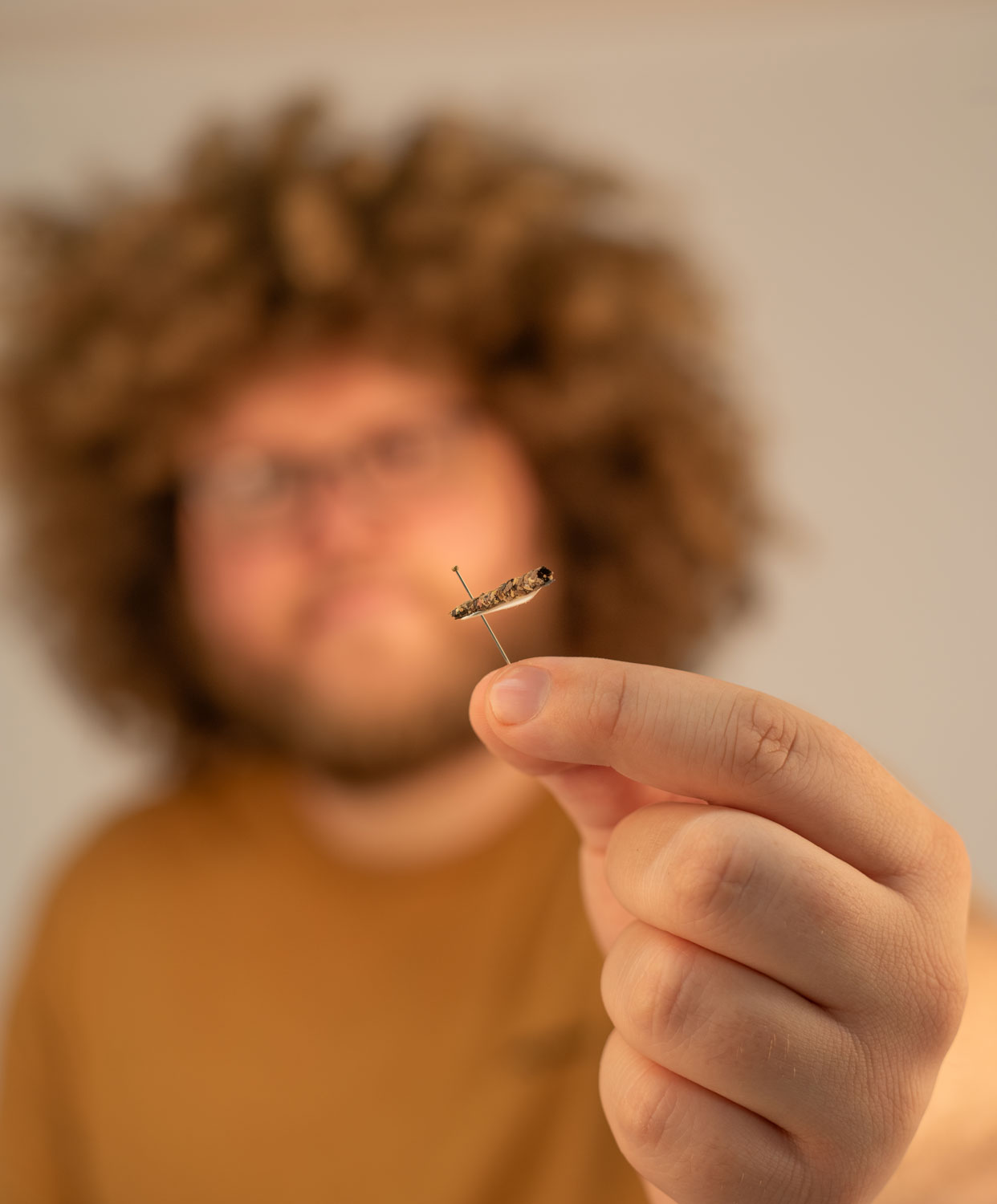
One caddisfly case contained three “striking yellow particles.” The team looked at the particles using EDX, or energy-dispersive X-ray spectroscopy, which let them “see” what the particles were made of. EDX analysis revealed that the still-intact particles contained sulfur, titanium, zinc, barium, and lead—all common additives to plastic. The year the caddisfly case had been collected: 1971. That was 47 years before discovery of the plasticky caddisfly homes found in Spain and England.
Coincidentally, 1971 was the same year that scientists first identified microplastics in the wild, in water samples from the North Sea containing “embarrassing proportions” of colorful synthetic fibers.
A second caddisfly case that Hiemstra’s team examined, from 1986, contained bright blue bits that the researchers suspected originally had been packaging material or insulation. EDX testing revealed that the bits contained chlorine and titanium, which are also common plastic additives. And the blue bits melted when heated, eliminating the possibility that they were ceramic.
This isn’t the first time scientists have found evidence of microplastics by looking to the past. Scientists found microplastics in fish specimens that had been caught in the 1950s and kept in a museum collection. But those fish were caught in an urban waterway around Chicago, Illinois, where a person could almost expect to find such pollution, says Hiemstra. The caddisfly cases in his study were taken from the headwaters of forested streams in the Netherlands that had no development nearby. “Even those places were already polluted by microplastics, which was a mind-blowing revelation,” he says. His resulting peer-reviewed study is the first to show historic microplastics in invertebrates using a natural history collection.
The findings didn’t overly surprise David Houghton, a caddisfly expert at Michigan’s Hillsdale College. While some caddisfly species are “extremely fussy” and only use specific materials, others will grab whatever is handy to build their cases, Houghton says.
The study’s implications concern him, though. “For every particle that we see, there are probably thousands that are submicroscopic that we can’t see,” he says. “There have been some studies on shrimp and things like that where a lot of what they’re eating is literally plastic. And that’s going to have huge implications.” One impact could be on the health and longevity of caddisflies themselves, which are a significant food source for fish and some birds around the world. The microplastics also could biomagnify up the food chain, wreaking havoc on not just fish but all the creatures that eat them—just as DDT did decades ago, Houghton says. If caddisflies eat plastic, then trout eat the caddisflies, and humans eat the trout—“at some point this becomes a real problem,” he says.
Hiemstra hopes this work encourages more studies about microplastics in fresh water. To date, fewer than 4 percent of microplastic studies involve fresh water. Yet, he says, “this is the water we come in contact with so often—I mean, we build our cities next to these rivers.”
He also hopes the study demonstrates the incredible value of museum natural history collections, which to many people seem dusty relics of another age. At a time when the world is changing swiftly, these collections may end up containing all sorts of information about what the world was like—and where it’s headed.
Hi, I’m Dave, the executive director of bioGraphic. (And that’s my dog, Finn.) Thanks for taking the time to read this story.
Stories like this simply don’t get produced without financial support from readers like you. bioGraphic is an independent non-profit—we’re not backed by a private company or owned by a billionaire. One-quarter of our budget comes directly from reader donations.
bioGraphic publishes environmental reporting that you can’t find anywhere else: deeply researched, trustworthy stories that are also beautiful and captivating to read. Right now, we need your help to raise $30,000 by October 2. Every dollar will go directly to more crucial reporting projects.
Around the world, governments are slashing funding for conservation and scientific research, placing even more ecosystems and wildlife at risk. At bioGraphic, we’re steadfastly shining a light on the threats to our planet’s incredible biodiversity. And we’re showcasing the hard work of people bravely taking action to protect at-risk species.
bioGraphic offers an antidote to apathy and doom-and-gloom news by revealing the wonders of the natural world and focusing on real solutions to big problems. When you finish a bioGraphic story, we want to leave you feeling informed, delighted, and inspired.
We don’t run ads or hide our stories behind a paywall. The readers who generously support bioGraphic allow our work to remain free for everyone.
We reached our goal, but there’s time left. Will you help us smash our original goal and reach a new goal of $30,000 by October 2?

Related Articles
When it Comes to Frog Sex, Teamwork Makes the Dream Work
New science on gray foam-nest tree frogs hints at the evolutionary benefits of multiple sexual partners.
How Much Plastic Does it Take to Kill a Seabird?
For the first time, researchers uncover how eating plastic trash may impact seabirds at the population level.
Shrimp Shell Slurry to the Rescue?
A new, multistep chemical process can turn bits of organic waste into “carbon-negative” fuel, food, and construction material.
